You’ve probably heard some version of “learning an instrument is good for your brain” enough times that it’s started to sound like a platitude, the kind of thing people say without really meaning anything by it.
Turns out, there’s real research behind it. Not the vague, feel-good kind, either, but actual studies measuring memory, attention, stress hormones, and brain function in people who play versus people who don’t. Here are five benefits that hold up when you actually look at the science.
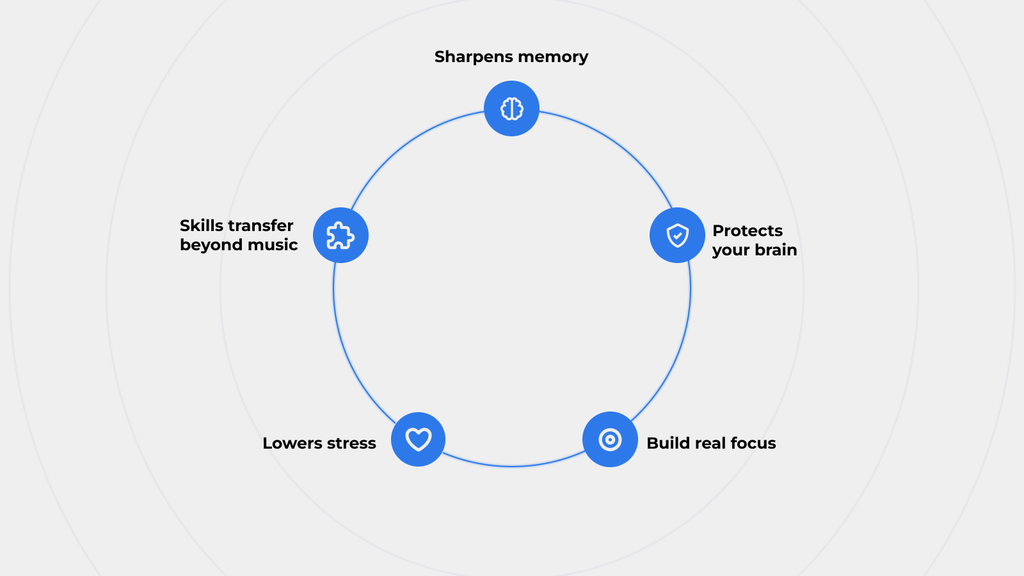
It Sharpens Your Memory
This is one of the more consistent findings in the research. A large-scale look at memory studies (summarized by Nature Index’s coverage of musical training) found that musicians consistently outperform non-musicians on short-term and working memory tasks – the effect is strongest for musical/tonal material, but it shows up for verbal memory too.
It makes sense when you think about what practicing actually involves: you’re constantly holding a sequence in your head – a chord progression, a rhythm, a melody – while your hands do something else entirely.
That’s memory training, disguised as something fun.
It Helps Protect Your Brain As You Age
This one has genuinely solid backing. A population-based twin study out of Sweden (Balbag, Pedersen & Gatz, 2014) compared elderly twins where one played an instrument and the other didn’t – the musical twin had a 64% lower likelihood of developing dementia or cognitive impairment.
A separate systematic review and meta-analysis (Román-Caballero et al., 2018, published in PLOS ONE) backed this up, linking musical practice to better-preserved cognitive function in healthy aging – and the protective effect showed up even in people who picked up an instrument later in life, not just lifelong musicians.
Translation: it’s genuinely never too late to start, and your brain will thank you for it decades from now.
It Builds Real Focus
This isn’t just “concentration while you’re practicing”. We’re talking actual, transferable attention. A widely-cited neuroscience review (published in Frontiers in Neuroscience, 2014) found musical training linked to improvements in attention, cognitive flexibility, and processing speed – the kind of executive function skills that show up well outside of music.
Every time you sight-read a new piece or train your ear to catch a wrong note, you’re exercising the exact mental muscle that helps you focus on anything else in life that requires sustained attention.
Drums offer a particularly striking example. A 2019 MRI study out of Ruhr-Universität Bochum compared professional drummers to non-musicians and found real structural differences in the corpus callosum – the main bridge between the brain’s two hemispheres.
Here’s a cool image of a drummer’s brain:
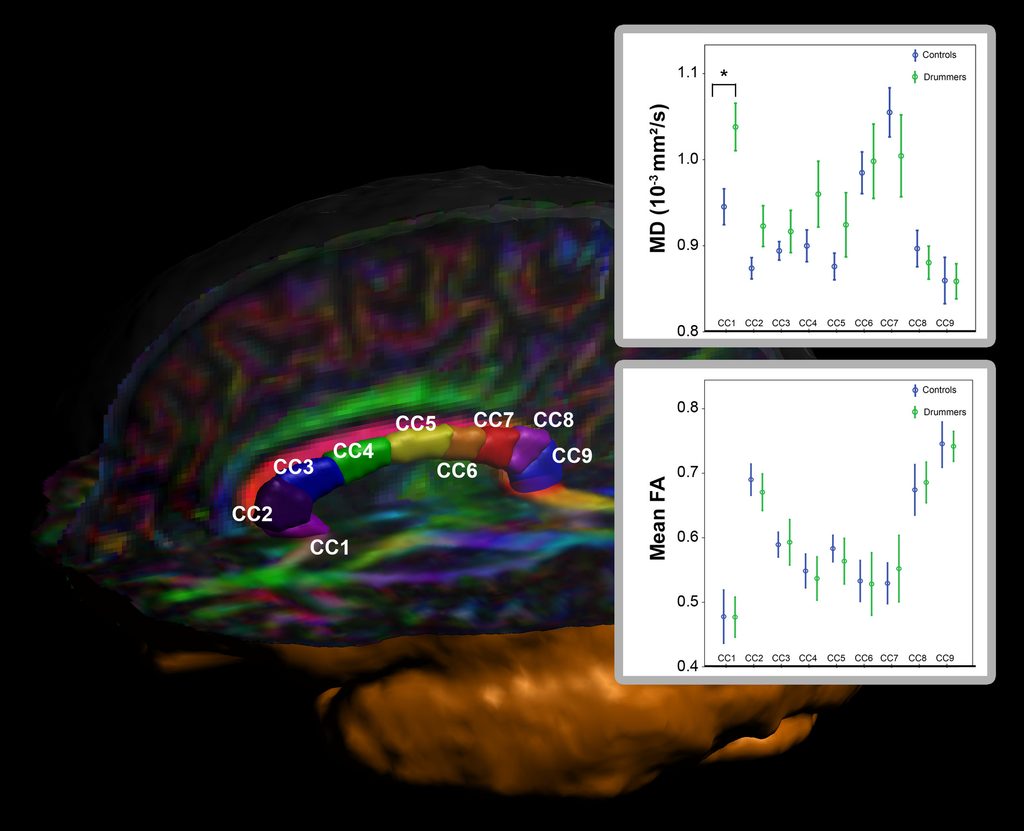
Basically, they found that drummers have:
- A way thicker “cabling” connecting the left and right sides of the brain
- More efficient wiring in the areas responsible for planning movement
- And when drumming, their brains actually use less power to pull off the same complex motor tasks than non-drummers – a pattern researchers call “neural efficiency,” and one that’s also shown up in studies on highly intelligent people.
It Genuinely Lowers Stress (In the Moment)
Here’s a nuance worth knowing: performing under pressure can actually raise your stress hormones. But a study on singing specifically (Fancourt et al.) found that low-stress singing – the kind you do for yourself, not in front of a judging panel – measurably lowered cortisol, the body’s main stress hormone.
So the calming effect is real, but it’s about how you’re engaging with music, not just that you are. Ten unpressured minutes of playing for yourself is doing something genuinely physiological, not just a nice feeling you’re imagining.
The Skills Transfer Beyond Music
Several reviews of the research link musical training to benefits that have nothing to do with music directly – better verbal memory, stronger reading ability, and more accurate pronunciation when learning a second language, particularly when training starts in childhood. Some studies have even found that learning an instrument as a kid predicts academic performance later on.
This is the benefit that surprises people most: music lessons aren’t just music lessons. They’re quietly building skills your kid (or you) will use everywhere else.
The Instrument Doesn't Matter As Much As Starting
Here’s the thing about all five of these benefits: none of them are specific to one instrument. Piano, guitar, drums, bass, singing – the research doesn’t point to one being “better for your brain” than another. What matters is consistent, engaged practice, not which instrument you picked.
So if you’ve been on the fence about starting, this is the sign. Pick whichever one you’re actually excited about, and the benefits above start compounding from day one.
Here’s How to Take the First Step
Try Musora: Musora offers a structured, step-by-step learning path with video lessons from world-class teachers in piano, guitar, drums, bass, and voice. You’ll get feedback from real instructors, interactive practice tools, and support from a community of >100,000 aspiring musicians in the same boat as you. Your first week is completely free, so you can try the full experience before deciding if it’s right for you.
Click here to start your free 7-day trial.
Learning music is one of the most rewarding things you can do. It doesn’t require natural talent. It doesn’t require starting young. It requires 10–15 minutes a day, a willingness to sound rough for a little while, and a clear path forward. And somewhere in there — don’t forget to have fun with it.