You want to learn drums. Maybe you’ve been tapping out beats on your steering wheel for years. Maybe you just watched a drum cover online and thought, I want to be able to do that.
You can. It’s never too late to start, and contrary to popular belief, you don’t need a natural sense of rhythm. All you need is a place to start – and something to hit.
This guide walks you through everything you need to go from a complete beginner to playing your first real groove. No prior experience or music theory required. Just you, something to hit, and about 10–15 minutes a day.
We’ll cover what gear you actually need, how to set up your body and grip, how the kit is laid out, your first coordination exercise, and your first full beat – the same basic pattern behind thousands of songs. By the end, you’ll have a clear starting point and a companion guide covering exactly what to expect month by month after that.
This guide is based on how we teach over 100,000 students at Musora, including our Getting Started On The Drums course with Domino Santantonio – one of the most popular online drum instructors who’s helped millions of beginners play their first beats and songs through Drumeo on Musora.
Choose Your Gear
The first question every beginner asks: Do I need a full drum kit? No, not to start.
What to look for:
- An electronic kit or practice pad, if noise or space is a concern. Electronic kits let you practice with headphones, which gives you the freedom to practice late into the night. If that’s not an option, a practice pad works just fine to get started.
- A pair of drumsticks in a beginner-friendly weight — 5A is the standard starting point for most players.
- A metronome or click track app. Timing is the single most important skill you’ll build early, and a metronome is non-negotiable for that. You can find metronomes everywhere – Google even has one built in for free (just type metronome into the search bar).
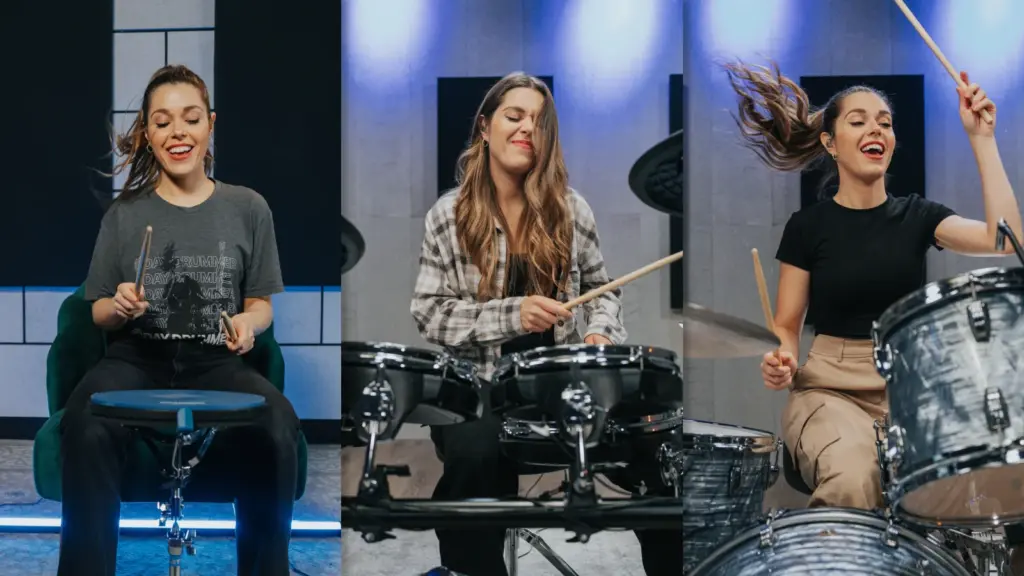
What you don’t need (yet): a full acoustic kit, cymbals beyond a hi-hat and one crash, or a dedicated practice room. A practice pad and a metronome will get you through your first weeks.
Electronic kits from Roland, Alesis, and Yamaha in the $400–$900 range serve beginners well for years. If the budget’s tight, a practice pad setup costs a fraction of that and will still allow you to build real technique.
Tip: Set your kit or pad up somewhere you’ll actually sit down at it daily. Gear that’s inconvenient to reach doesn’t get played – and the best drum kit in the world does nothing sitting in a closet.
Get Comfortable Behind the Kit
Before you play a single beat, let’s talk setup. Bad posture and grip habits formed in week one can slow you down for months.
- Sit with your thighs roughly parallel to the ground, throne height adjusted so your knees are slightly lower than your hips.
- Use a matched grip to start – both hands holding the sticks the same way, thumb and index finger forming a fulcrum roughly a third of the way up the stick.
- Keep your wrists loose. Tension is the enemy of speed and control – a tight grip feels “in control” but actually slows you down.
- Position your kick pedal so your heel can rest down or stay up, whichever feels more stable – both are valid techniques, and you’ll develop a preference over time.
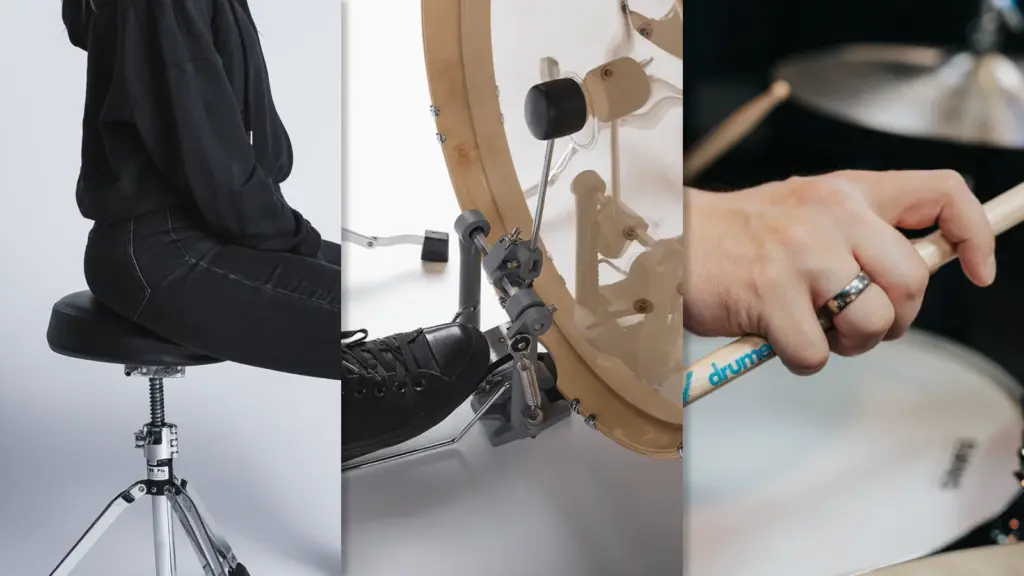
Spend a few minutes just sitting at the kit, getting comfortable with where everything is, before worrying about playing anything.
Learn the Kit Layout
A full kit looks like a lot of moving parts. Here’s the simplified version: almost everything you’ll play as a beginner comes down to four pieces.
- Kick drum. Played with your right foot (for most right-handed setups). This is the low, thumpy driving sound that anchors the beat.
- Snare drum. Played with your left hand (for most right-handed setups), this is the sharp crack that defines the backbeat.
- Hi-hat. Played with your other hand, the steady ticking pulse that holds the groove together. Your left foot controls how open or closed it sounds.
- Toms and cymbals. Used for fills and accents once you’re feeling comfortable with the basics.
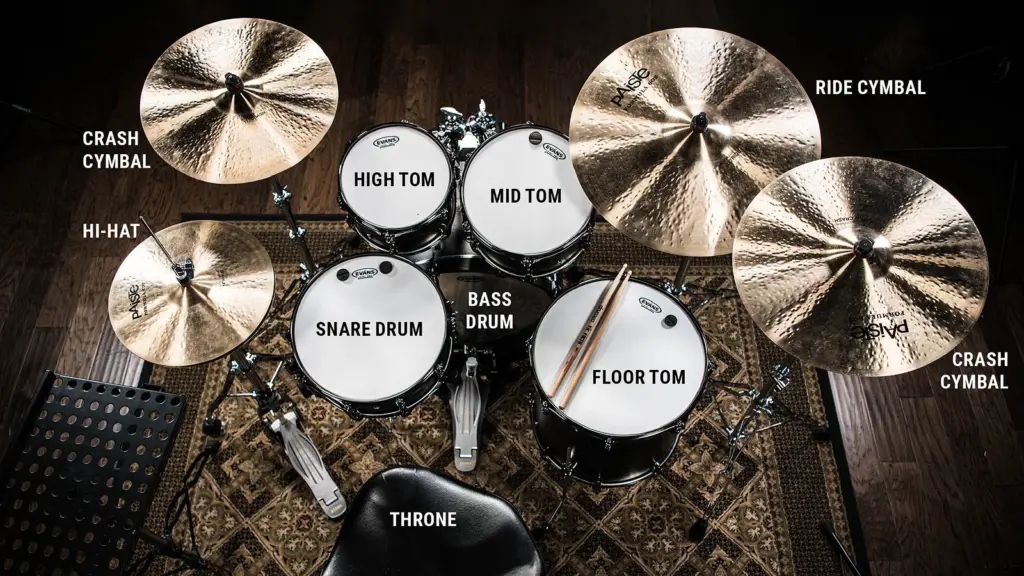
Everything you play at the beginner level is some combination of kick, snare, and hi-hat. Master that combination, and you’ll set yourself up to play thousands of songs down the line.
Play Your First Exercise & Beat
This is the exercise every beginner drummer starts with, because it isolates the hardest part of drumming: making your limbs do different things at the same time.
The basic pattern:
- Right foot (kick) on beats 1 and 3
- Left hand (snare) on beats 2 and 4
- Right hand (hi-hat) playing a steady eighth-note pulse throughout
Start slow – really slow – and isolate each limb before combining them. Kick alone. Snare alone. Hi-hat alone. Then kick and snare together. Then add the hi-hat last.
This is going to feel strange at first. That’s completely normal – coordination is a skill that builds with repetition, not something you either have or don’t. Every drummer you’ve ever admired started exactly here, feeling just as uncoordinated.
And here’s the really cool part: once you’ve nailed this exercise and combined your limbs, you’re already playing your first beat! This is called the “money beat” – and it’s one of the most famous and foundational drum grooves in popular music.
For step-by-step video lessons, check out our free Getting Started on the Drums series with Domino.
Understand Basic Drum Notation
You don’t need to become a sight-reading expert to play drums, but understanding the basics opens up a lot of learning resources.
Drum notation uses a simplified staff where each line and space represents a different drum or cymbal — kick on the bottom space, snare in the middle, hi-hat above the staff. Rhythms are written the same way as any instrument: whole notes, half notes, quarter notes, eighth notes, based on how many beats they last.
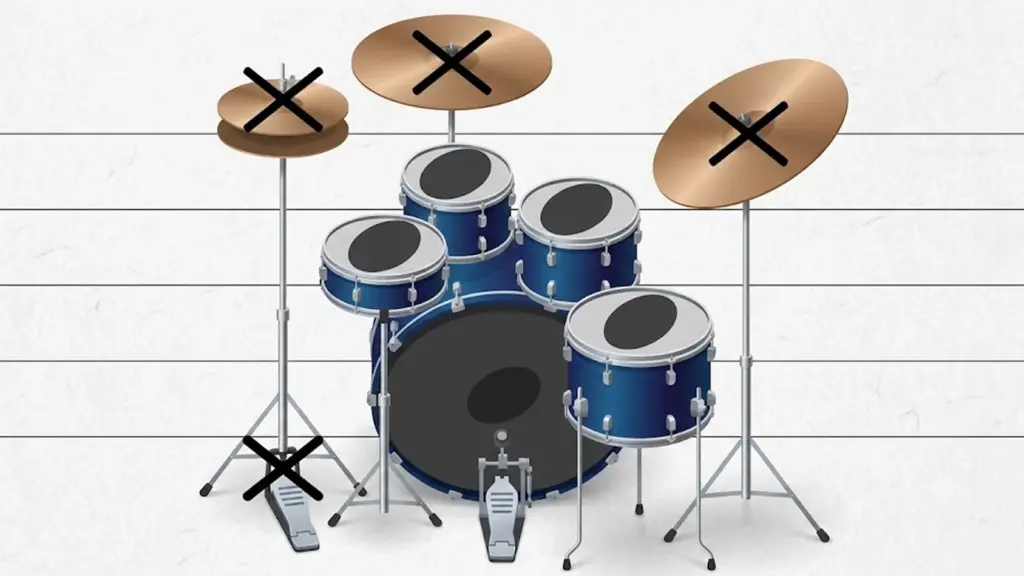
You don’t need to memorize this all at once — the goal is recognizing that notation is a learnable system you can pick up gradually.
For a deeper dive, see: How To Read Drum Music (For Beginners) (Coming soon)
Put It All Together: Play Along to a Song
Pick a song with a simple, steady beat — classic rock and pop songs like AC/DC’s “Back In Black” or Michael Jackson’s “Beat It” are great for this, since the drum parts are usually clear and repetitive. Play the beat you just learned alongside the recording.
Don’t worry about playing every fill or accent the original drummer plays – just lock in with the kick, snare, and hi-hat pattern and stay in time. That’s a real, functional drum part, and it’s the same foundation every drummer builds on.
And if you’re on a practice pad, don’t worry! Just play with both hands on the pad, and stomp lightly with your right foot to mimic the kick drum.
For song recommendations at this level, check out: 5 Easy Drum Songs For Beginners. (Coming soon)
What to Practice (And How Often)
Consistency beats intensity. 10–15 minutes a day, 5 times a week, gets you further than one long weekend session.
A simple daily routine:
As you improve, extend to 20–30 minutes – but don’t sacrifice consistency for length.
For more on this, read: How To Build A Practice Habit That Sticks (For Musicians) (Coming soon)
Common Beginner Mistakes to Avoid
After teaching over 100,000 students, we’ve seen the same mistakes come up again and again. Avoid these, and you’ll progress faster than most:
- Rushing to full speed. It’s tempting to push tempo before a pattern actually feels solid. But speed is a byproduct of accuracy – play everything slowly enough that you can do it correctly, then gradually increase tempo.
- Gripping the sticks too tightly. A tight grip feels like control, but it’s actually the opposite – it restricts your wrist and slows down every stroke. Relaxed hands move faster and last longer before fatigue sets in.
- Ignoring the metronome. It’s not a training-wheels tool you graduate away from. Even advanced drummers practice with a click. Skipping it early means building timing habits you’ll have to fix later.
- Skipping isolated-limb practice. Jumping straight to full beats without isolating kick, snare, and hi-hat separately first means you’re building coordination and technique at the same time – which is much harder than building them one at a time.
- Learning without structure. Watching random drum videos is fun, but without a clear progression path, you end up with coordination gaps that show up later as bad habits. A structured method – like the Drumeo Method – ensures you build each skill in the right order.
For the full list, read: The Most Common Mistakes Beginner Drummers Make. (Coming soon)
Where to Go From Here
You’ve got the foundation – gear, setup, coordination, your first beat, and a way to play along to real music.
Here’s How to Take the Next Step:
Start free: Drumeo’s Getting Started On The Drums series is free — a step-by-step introduction to drumming with Domino Santantonio that takes you from complete beginner to playing your first real beats.
Go deeper: The Drumeo Method gives you a structured, step-by-step curriculum with video lessons from the world’s best drum instructors – the same coordination-building progression that gets total beginners playing real songs. You’ll also get access to 1,500+ songs to play through, with interactive tools that let you remove the drums, slow down the tempo, and loop the tricky parts until they click. It’s how over 100,000 music students are reaching their musical goals. Click here to start your 7-day free trial.
Keep learning here: This guide is part of a series. Explore our guides on drum rudiments, drum notation, beats and fills, and easy songs to build your skills.
Learning drums is one of the most rewarding things you can do. It doesn’t require natural rhythm. It doesn’t require starting young. All it takes is 10–15 minutes a day, a willingness to feel uncoordinated for a little while, and a clear path forward. You’ve got nothing to lose and a whole new way to have fun.