You want to learn piano. Maybe you’ve wanted to for years. Maybe decades. Maybe you just walked past a keyboard in a store and thought, I wonder if I could actually do that.
The answer is yes. And it’s simpler to get started than most people think.
This guide walks you through everything you need to go from a complete beginner to playing your first song. No prior experience or music theory needed. Just you, a keyboard, and about 10 minutes a day.
We’ll cover how to choose a keyboard, where to put your hands, how to find every note, how to read basic music, and how to play your first chord progression – the same progression behind hundreds of popular songs. By the end, you’ll have a clear starting point for your first weeks at the piano – and a companion guide covering exactly what to expect month by month after that.
This guide is based on how we teach over 100,000 students at Musora, including our Getting Started On The Piano course with Lisa Witt – a Royal Conservatory-trained pianist who’s helped millions of beginners play their first notes through Pianote on Musora.
Choose the Right Keyboard
The first question every beginner asks: What piano should I buy? Good news – you don’t need anything expensive to start. Here’s what actually matters.
What to look for:
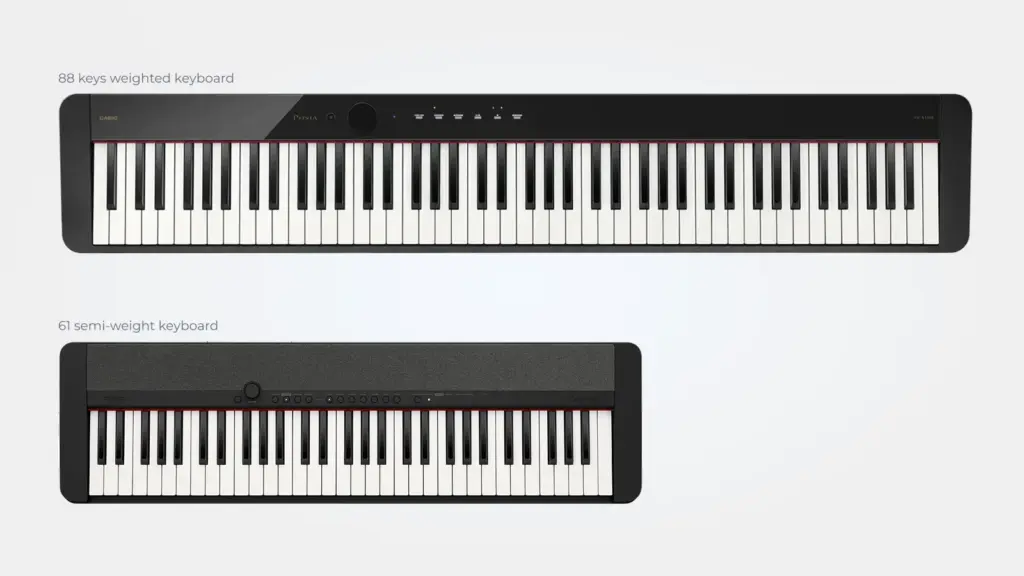
- 88 weighted keys. Weighted keys feel like a real piano and build proper finger strength from day one. If your budget is tight, 61 semi-weighted keys will work for the first few months, but you’ll outgrow them.
- A sustain pedal input. You’ll need this once you start playing songs. Most digital pianos include one.
- A headphone jack. Practice at midnight without waking anyone up.
What you don’t need (yet): hundreds of built-in sounds, a recording interface, Bluetooth connectivity, or an acoustic piano – digital is actually better for beginners, thanks to the headphone jack and consistent tuning.
A solid digital piano in the $300–$700 range will serve you well for years. Yamaha, Roland, Casio, and Korg all make excellent beginner instruments. On a tighter budget, even a basic 61-key keyboard gets you through the first few months — plan to upgrade once you’re committed.
Tips: Set your keyboard up somewhere you’ll see it every day. If it’s tucked away in a closet, I guarantee you won’t play it.
Get Comfortable at the Keyboard
Before you play a single note, let’s talk about how to sit. Bad posture habits formed in week one can slow you down for months.
- Sit at the center of the keyboard. Find the brand logo – that’s roughly the middle.
- Sit at the edge of your bench, not the back. Feet flat on the floor, stable but not stiff.
- Keep your wrists up, floating above the keys, roughly level with your forearms. Don’t let them drop – that’s the fastest path to tension and fatigue.
- Curve your fingers gently, like you’re holding a tennis ball. Play with your fingertips, not flat fingers.
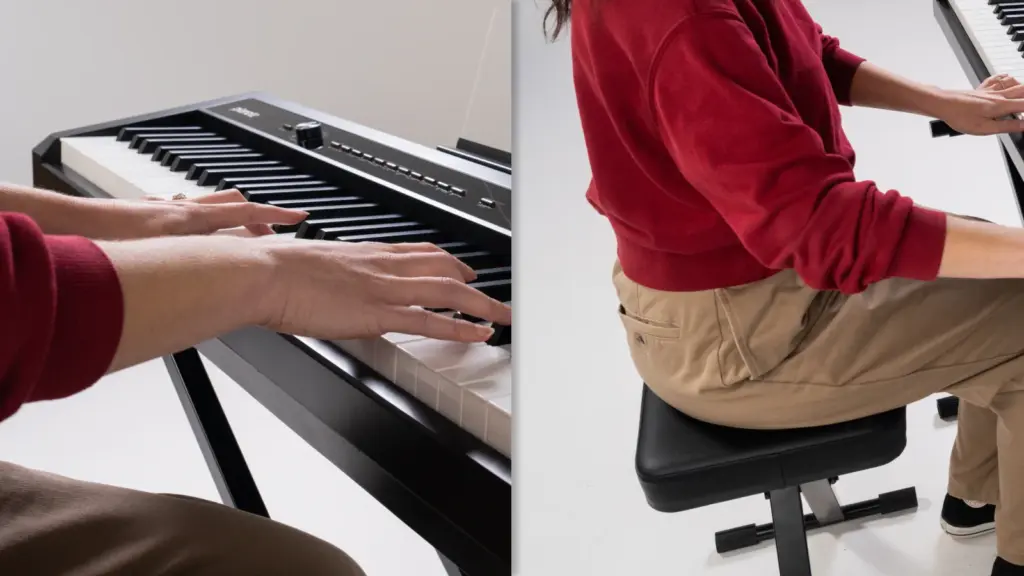
Spend a few minutes just resting your hands on the keys and pressing a few notes. You’ll probably notice that your thumb is strong, and your pinky is weaker. Don’t worry, that’s normal, and it gets stronger with practice (promise).
Learn the Keyboard Layout
A full piano has 88 keys, which looks overwhelming. Here’s the secret: there are only 12 unique notes, repeating over and over left to right. Learn the pattern once, and you know the entire keyboard.
Look at the black keys – they come in alternating groups of two and three. That pattern is your map. The musical alphabet uses seven letters (A through G), then starts over – seven white keys, five black keys, twelve notes total per octave.
Finding the most important notes:
- Middle C: Find a group of two black keys near the center of the keyboard. The white key immediately to the left is C. The one closest to the middle of the keyboard is Middle C – your home base.
- D: the white key between the two black keys.
- E: the white key to the right of the two black keys.
- F, G, A, B: continue up the white keys – F sits left of the group of three black keys, then G, A, B, and you’re back to C.
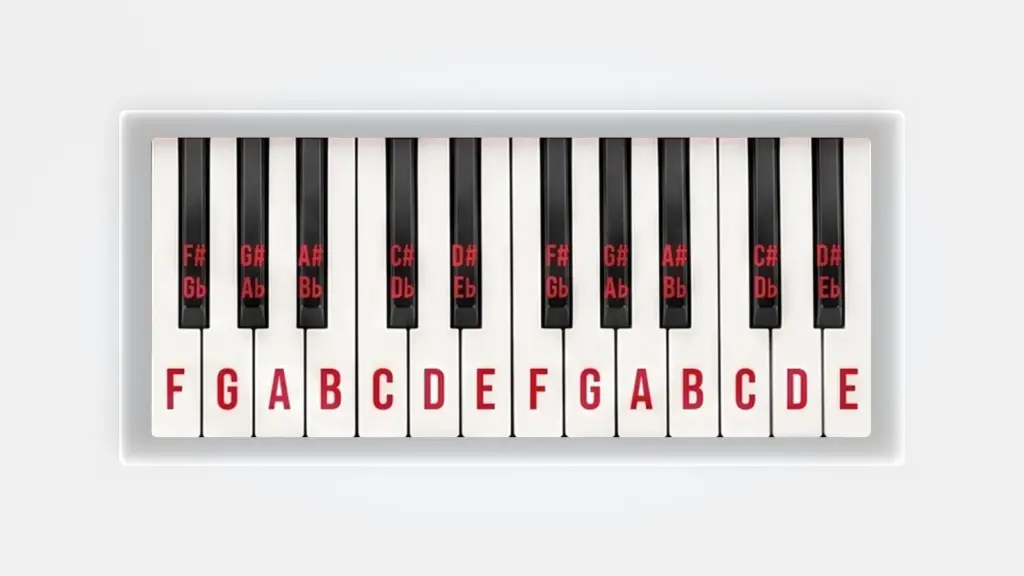
Practice this: starting at Middle C, say each note name out loud as you play up the white keys, then back down. Repeat until you can find any note quickly using the black-key groups as landmarks. This is exactly how our piano teacher, Lisa Witt, starts every beginner in Musora’s Getting Started On The Piano course
Play Your First Scale
A scale is a sequence of notes played in order – the foundation for melodies, chords, and songs, and the best way to build finger coordination early.
The C major scale:
Start on Middle C with your right-hand thumb (finger 1).
- Thumb (1) → C
- Index (2) → D
- Middle (3) → E
- Then tuck your thumb under to reach F — the tricky part.
- Then thumb (1) → F, index (2) → G, middle (3) → A, ring (4) → B, pinky (5) → C
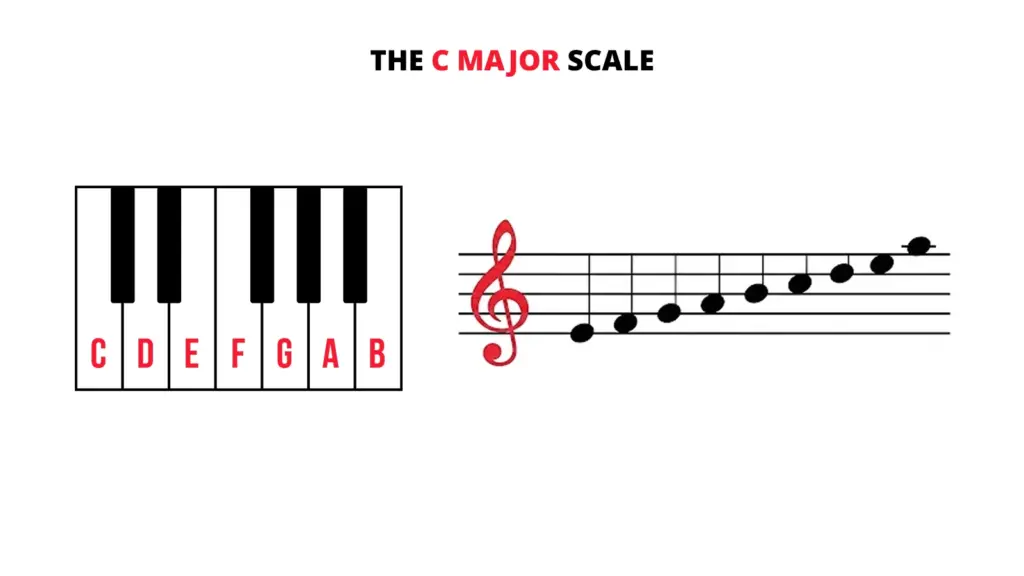
The thumb-under technique feels awkward at first. Start slowly, and focus on keeping each note even — speed comes later, smoothness comes first.
If the full eight-note scale feels like too much, start with a five-finger pattern instead: C, D, E, F, G, up and back down. This is how Pianote’s beginner curriculum introduces your very first exercises.
Practice your scale for 2–3 minutes at the start of each session — it doubles as a warm-up and a skill-builder.
Understand How to Read Basic Music
You don’t need to become a sight-reading expert to play piano, but the basics open up a world of songs and resources.
Music is written on a staff – five horizontal lines. The right hand typically reads the treble clef. Lines bottom to top: E, G, B, D, F (Every Good Boy Does Fine). Spaces bottom to top: F, A, C, E (FACE).
Most beginner songs use 4/4 time — four beats per measure. A whole note holds for 4 beats, a half note for 2, a quarter note for 1. Don’t try to memorize all of this at once – the goal here is just recognizing that notation is a learnable system.
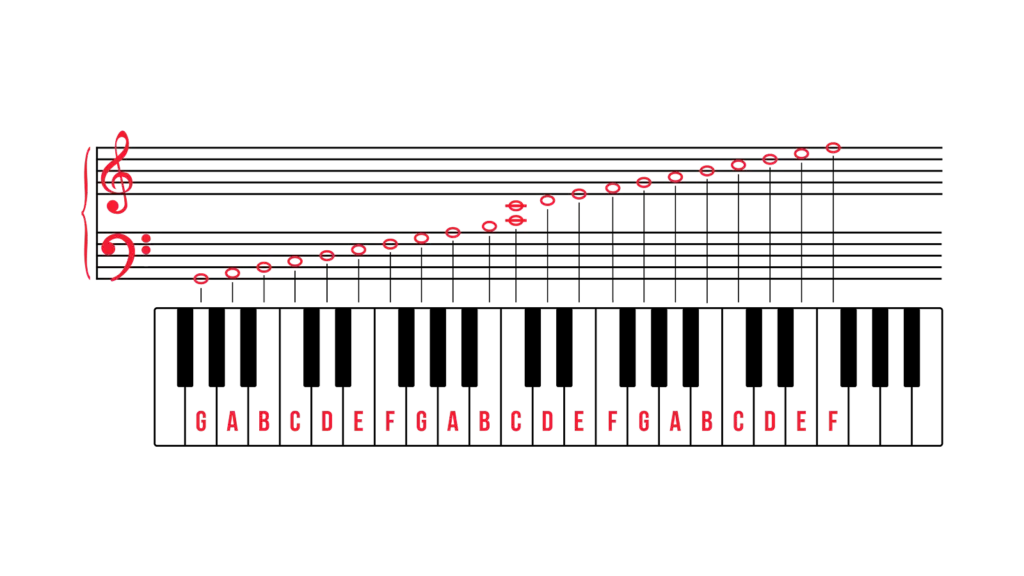
For a deeper dive, see: How To Read Sheet Music: A Simple Guide for Any Instrument (coming soon).
Play Your First Chords
Chords are what make the piano sound full and musical – three or more notes played together. With just four chords, you can play hundreds of popular songs.
The I–V–vi–IV progression, in the key of C:
- C major: C, E, G
- G major: G, B, D
- A minor: A, C, E
- F major: F, A, C
Play them in order — C → G → Am → F – and repeat. This is one of the most common chord progressions in music, and it’s exactly what Lisa Witt teaches in Lesson 3 of the Getting Started course.
Start by playing just the root note with your left hand while your right hand plays the full chord – a low C under a C-E-G, for example. This is your first step toward playing with both hands.
For a complete breakdown with diagrams, see: Essential Piano Chords For Beginners: The Only Guide You’ll Need. (Coming soon)
Put It All Together: Your First Song
/You know the keyboard, you can find notes, and you can play a chord progression. Now let’s make music.
Take your C-G-Am-F progression: left hand plays the root note of each chord, holding four beats; right hand plays the full chord on beat 1 of each measure. Count out loud – 1-2-3-4 – to keep your rhythm steady.
Once that’s comfortable, try breaking up the right-hand chords into single notes played one at a time (an arpeggio) instead of all at once. It sounds more musical and gives you something new to practice.
That’s real music, built on the same foundation every pianist starts with.
For more songs at this level, check out: 5 Easy Piano Songs For Beginners. (Coming soon)
What to Practice (And How Often)
Consistency beats intensity. Ten minutes a day, five days a week, gets you further than a two-hour weekend marathon.
A simple daily routine:
- Minutes 1–3: warm up with the C major scale, both hands separately
- Minutes 4–7: practice your chord progression (C-G-Am-F) with both hands
- Minutes 8–10: work on a song or exercise from your current lesson
As you get more comfortable, extend to 15–20 minutes – but never sacrifice consistency for length.
For more on this, read: How To Build A Practice Habit That Sticks (For Musicians). (Coming soon)
Common Beginner Mistakes to Avoid
After teaching over 100,000 students, we’ve seen the same mistakes come up again and again. Avoid these, and you’ll progress faster than most:
- Skipping the fundamentals. It’s tempting to jump straight to your favorite song. But building basic technique first (posture, finger position, scales) makes everything easier later.
- Practicing only what you’re good at. That chord progression that sounds great? You don’t need to practice that one anymore. Spend your time on what’s hard.
- Going too fast. Speed is a byproduct of accuracy. Play everything slowly enough that you can do it correctly, then gradually increase tempo.
- Ignoring the left hand. Most beginners focus on the right hand because it plays the melody. But your left hand provides the foundation. Give it equal time.
- Learning without structure. Watching random YouTube tutorials is fun, but without a clear progression path, you end up with gaps in your skills. A structured method – like Musora’s Pianote Method – ensures you build each skill in the right order.
Where to Go From Here
You’ve got the foundation — the keyboard, basic notation, chords, and a first song. Wondering what “normal” progress looks like from here? We’ve laid out exactly what to expect, month by month, in a companion piece.
Here’s How to Take the Next Step
Start free: Pianote’s Getting Started On The Piano course is free – 4 lessons with Lisa Witt that take you from your first note to playing a full chord progression.
Go deeper: The Pianote Method gives you a structured, level-by-level path with video lessons, theory, and ear training from real teachers. You’ll also get access to a 500+ song library to play through, with interactive practice tools that let you slow down and isolate any tricky section until it clicks. It’s how 100,000+ students learn.
Keep learning here: This guide is part of a series. Explore our guides on piano chords, music theory for beginners, reading sheet music, and easy songs to build your skills.
Learning piano is one of the most rewarding things you can do. It doesn’t require natural talent. It doesn’t require starting young. All it takes is 10 minutes a day, a willingness to sound bad for a little while, and a clear path forward.