

Forty rudiments sounds like a lot. But here’s the truth: you don’t need to master all 40 before you’re allowed to call yourself a real drummer. Not even close.
A handful of these rudiments will show up constantly in everything you play. The rest are tools you pick up as you need them. The key is knowing which ones to start with, how to practice them properly, and where to find the rest when you’re ready.
In this guide, you’ll learn how rudiments work, get a beginner-friendly starting point, and find individual lessons for all 40 official drum rudiments.
Let’s start with what a rudiment actually is, and why drummers practice them. 🥁
What Are Drum Rudiments (And Why Bother Learning Them)?
A rudiment is a specific, named pattern of strokes – single strokes, double strokes, flams, drags – that shows up again and again in real drumming.
Think of them less like “exercises” and more like vocabulary. They’re the building blocks behind everything you play on the drums.
Do you need a music degree or years of experience to start learning these? Nope. The process is the same for everyone – repetition, patience, and practicing with a metronome.
And you definitely don’t need to tackle all 40 at once. In fact, most beginners will make faster progress by focusing on a smaller group of rudiments that show up again and again behind the kit.
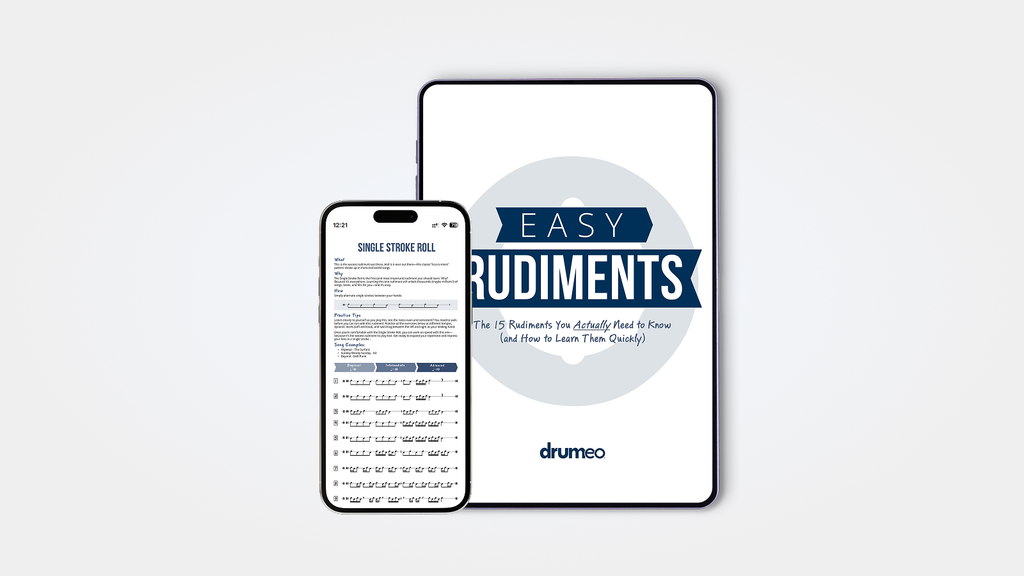
 Download Your Easy Rudiments E-Book
This handy e-book covers the 15 essential rudiments to start with – the ones that show up in almost everything you’ll ever play behind a kit.
We’ll also send you free lessons and special offers. Don’t worry, we value your privacy and you can unsubscribe at any time.
How To Actually Practice A Rudiment
Whether you begin with those 15 or choose another pattern from the complete list below, here’s how to practice any rudiment effectively:
- Start slow. Play the pattern slowly (well under any tempo that feels natural) enough that you don’t have to guess which hand comes next.
- Make every stroke consistent. Listen for even spacing, volume, and stick height.
- Add a metronome. Choose a tempo that lets you play the pattern cleanly and comfortably.
- Build the speed gradually. Increase the tempo in small steps, but only while the rudiment stays clean
- Bring it back down. Finish by gradually slowing the pattern down without losing control.
Tip: Don’t chase speed too early. A slow, even rudiment will do far more for your playing than a fast, sloppy one.
Once you understand that process, you can apply it to any of the 40 official rudiments below.
All 40 Rudiments
Ready to explore the complete collection? Click any rudiment below for a complete lesson showing you how to play it.
- Single Stroke Roll
- Single Stroke Four
- Single Stroke Seven
- Multiple Bounce Roll
- Double Stroke Roll
- Triple Stroke Roll
- Five Stroke Roll
- Six Stroke Roll
- Seven Stroke Roll
- Nine Stroke Roll
- Ten Stroke Roll
- Eleven Stroke Roll
- Thirteen Stroke Roll
- Fifteen Stroke Roll
- Seventeen Stroke Roll
- Single Paradiddle
- Double Paradiddle
- Triple Paradiddle
- Single Paradiddle-Diddle
- Flam
- Flam Accent
- Flam Tap
- Flamacue
- Flam Paradiddle
- Pataflafla
- Single Flammed Mill
- Flam Paradiddle-Diddle
- Swiss Army Triplet
- Inverted Flam Tap
- Flam Drag
- Drag
- Single Drag Tap
- Double Drag Tap
- Lesson 25
- Single Dragadiddle
- Drag Paradiddle #1
- Drag Paradiddle #2
- Single Ratamacue
- Double Ratamacue
- Triple Ratamacue
Want a version of this list you can keep next to your kit? That’s exactly what the poster below is for.
Where Rudiments Actually Show Up When You Play
Rudiments aren’t just something you drill on a practice pad and never touch again.
The single stroke rolls, the paradiddles, the flams – these patterns show up constantly inside real grooves and fills once you know what to listen for.
Once you’ve drilled a rudiment, slow-to-fast-to-slow, with a metronome, the next step is to drop it into a real song or a drumless loop.
That’s where it stops being “an exercise” and starts being something you actually play.
Want to Go Even Deeper?
If this clicked for you, you’re going to love exploring rudiments, fills, and technique even further inside Drumeo, which you can try with our free 7-day trial.
You’ll also get access to structured, step-by-step lessons and direct feedback from world-class instructors, so you’re not just practicing rudiments in isolation – you’re learning exactly how to use them.