

When you think about scales, you probably think “boring.” Something you have to practice, not something you want to practice.
I get it. I took piano lessons for years without ever asking myself why I was practicing them.
But once I did, I realized scales are magic.
Every song you’ve ever loved is built on a scale – what musicians call a “key.” Think of a scale as the DNA of a song. Once you know the scale, you know exactly which notes and chords are going to sound good together. That’s the missing link for a lot of students: scales aren’t just drills, they’re the map.
We’ll practice them the traditional way – up and down, hands together, with a metronome – because that builds the muscle memory for each key, along with the coordination, accuracy, and confidence that carry over into everything else you play.
So let’s get you started in a way that actually feels good. And if you want every scale, formula, and fingering to keep by your side as you go, grab our free Digital Chords & Scales Guide below before we dive in.
🎹 Get Your Free Digital Chords and Scales Book
Grab the ultimate chords and scales cheat sheet and practice at home.
We’ll also send you free lessons and special offers. Don’t worry, we value your privacy and you can unsubscribe at any time.
Your First Scale: C Major
We start here for a reason – C Major uses only the white keys from C to C, so all your energy goes toward building the foundation you’ll reuse in every scale after this one.
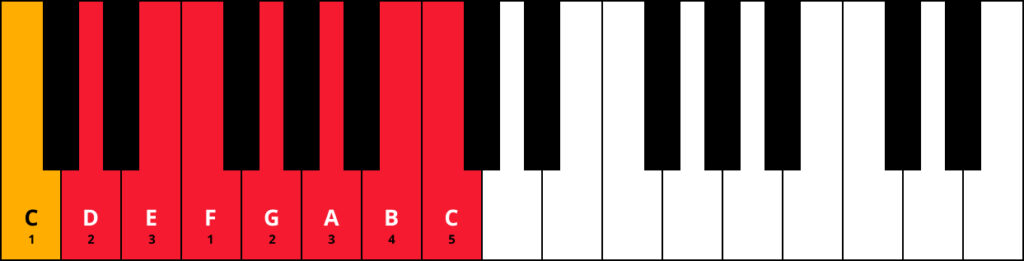
A few things to lock in early:
- Right hand first, then left, then hands together
- The thumb tuck – your thumb pivots under on the way up (fingers 3 and 5 land on notes 8 apart)
- Practice with a metronome. Hands separate will always be faster than hands together – start slow with both hands, and once you can hit 60 BPM with accuracy, you’re in great shape
The Most Important Beginner Scales
Once C Major feels comfortable, here’s where to go next.
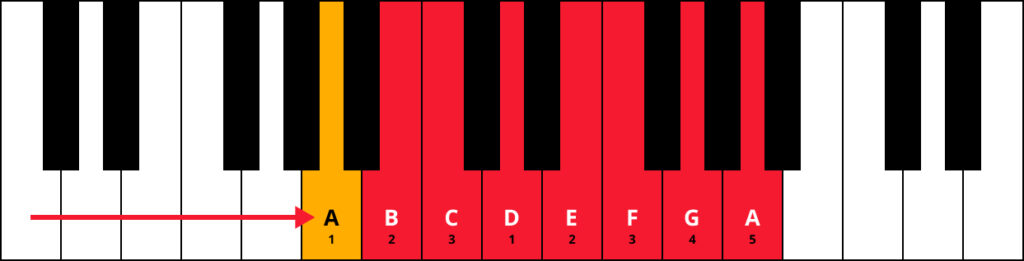
- A Minor. Every major scale has a relative minor – same notes, different starting point, totally different mood. Drop three half steps down from C, and you land on A. That’s C’s relative minor: moody, dramatic, and a nice contrast when you’re practicing.
I like to pair major and minor scales together in practice — a few minutes on C Major, then straight into A Minor. They complement each other beautifully.
- G Major / E Minor. This is your first scale with a sharp – F#. It’s an extremely common key, and it’s a great way to get comfortable reaching for that first black key.
Why does G need a black key when C didn’t? Look back at C Major – there’s a whole step between the first two notes. That whole-step-half-step pattern is the formula every major scale follows. Apply that same formula starting on G, and the black key becomes necessary, not optional.
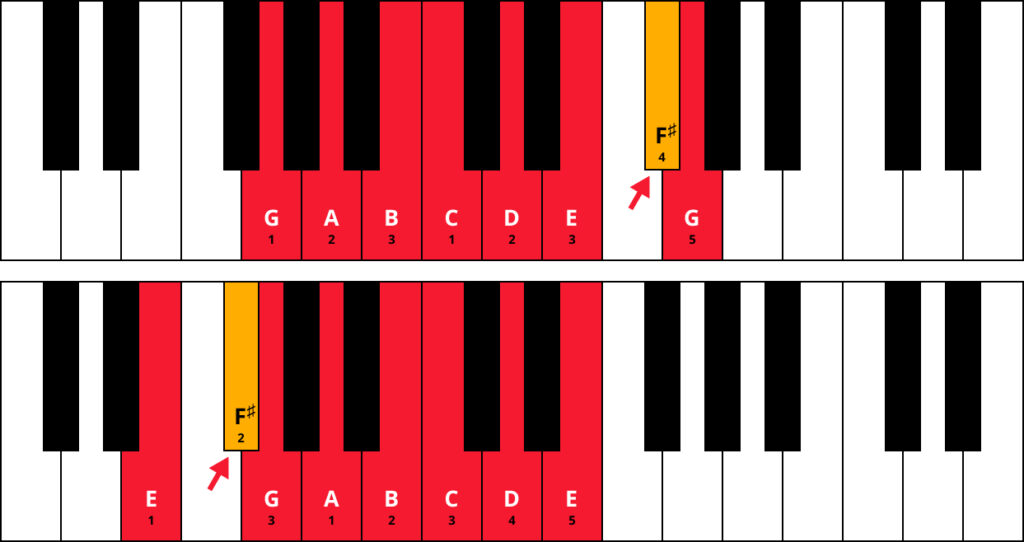
Drop down three half steps from G, and you land on E – G’s relative minor. All white keys except one: F becomes F#. This one will feel different under your fingers than A Minor did.
- F Major / D Minor. This pairing introduces your first flat — B♭ – and a different thumb-tuck pattern than the one you learned in C. It’s a great coordination challenge once the sharp keys feel natural.
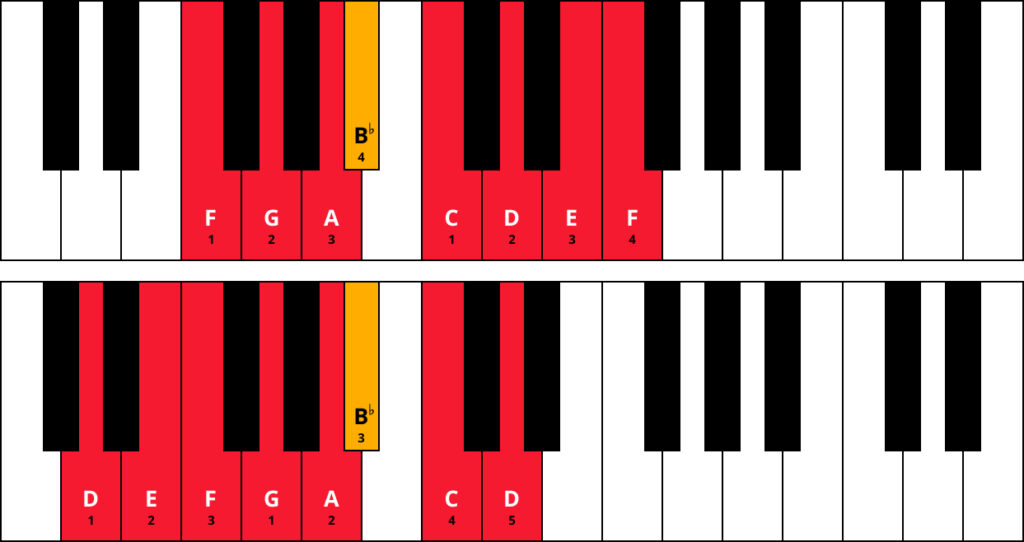
Once C, A minor, G, E minor, F, and D minor feel solid, you’ve got everything you need to branch out into the rest – and that’s exactly what’s covered in the free guide below.
A Different Way to Practice Scales
The usual stuff still matters – speed and accuracy goals, mixing in staccato and legato, playing with dynamics. But here’s how I like to make scales actually fun:
- Play diatonic chords. Build a triad on the first note of your scale, then move that same shape up the scale. You’re now using the scale itself to show you every chord that belongs in that key – solid or broken, don’t play it boring, have fun with it.
- Put chords underneath it. Take a scale – let’s use G Major – play it in your right hand, and have your left hand play the G and D chords underneath. Push it further: play only pieces of the scale, a few notes at a time, and just find what sounds nice to your ear. Congratulations – you’re improvising and songwriting, and you didn’t even notice it happening.
Your Scale Practice Plan
How often? How long? When do you move on? A few ways to structure it:
- Pick a major/minor pairing and stick with it for a full practice week (I count 5 sessions in 7 days as a week). Spend 5–10 minutes practicing the traditional way, then 5–10 minutes exploring and having fun with it.
- Or use scales as your warm-up – traditional practice with the metronome to start your session, then circle back at the end to improvise or build a chord progression from what you just played.
You don’t need total mastery before moving on. Spend a few days with a scale, and if you’re getting bored, move to the next one – just make sure you come back to it later. I’ve been playing my whole life, and I still practice the very first scale I ever learned. There’s always something new to find in it.
Want to Go Even Deeper?
If this clicked for you, you’re going to love exploring chords, formulas, and lead sheets even further inside Musora, which you can try with our free 7-day trial.
You’ll also get unlimited access to our step-by-step learning paths, 62 deep-dive courses, note-for-note breakdowns of over 1,000 songs in our lead sheet view, and so much more.