Short answer: With about 10–15 minutes of daily practice and a structured approach, most beginners can play a basic beat within their first couple of weeks, play along to full songs by month three, and develop real independence and fills by month six.
By the one-year mark, most players are developing their own feel and exploring different genres and grooves.
Is that fast? Faster than most people expect – drumming rewards consistency more than almost any other instrument.
Here’s what that actually looks like, month by month.
What Affects Your Timeline
Results vary, but consistency matters more than natural rhythm and talent. Someone practicing 10–15 focused minutes a day will consistently outpace someone practicing for two hours once a week – coordination is built through repetition, not talent.
Age isn’t a real factor either; the hands and feet learn new coordination patterns at any stage of life.
Practice Pad vs. Full Kit: Does It Change Your Timeline?
Not as much as people assume. The coordination and timing skills you build on a practice pad transfer directly to a full kit – what changes is just the physical setup, not the underlying skill.
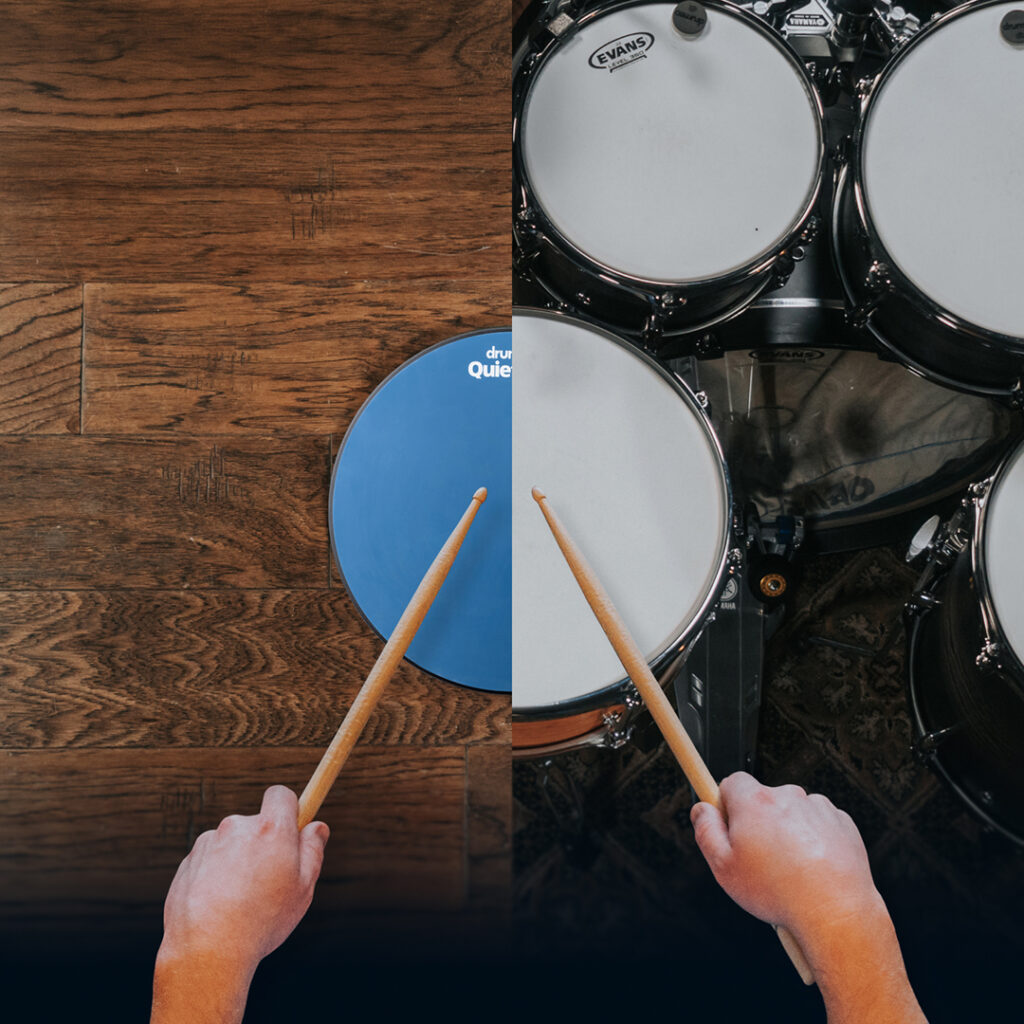
Some beginners actually progress faster on a pad early on, since there’s less to think about while the fundamentals are still forming.
That said, you’ll probably want to start playing on a full kit (either acoustic or electric) a couple of months in, so you get a feel for all the different surfaces and sounds. This will help your dynamic range in the long run.
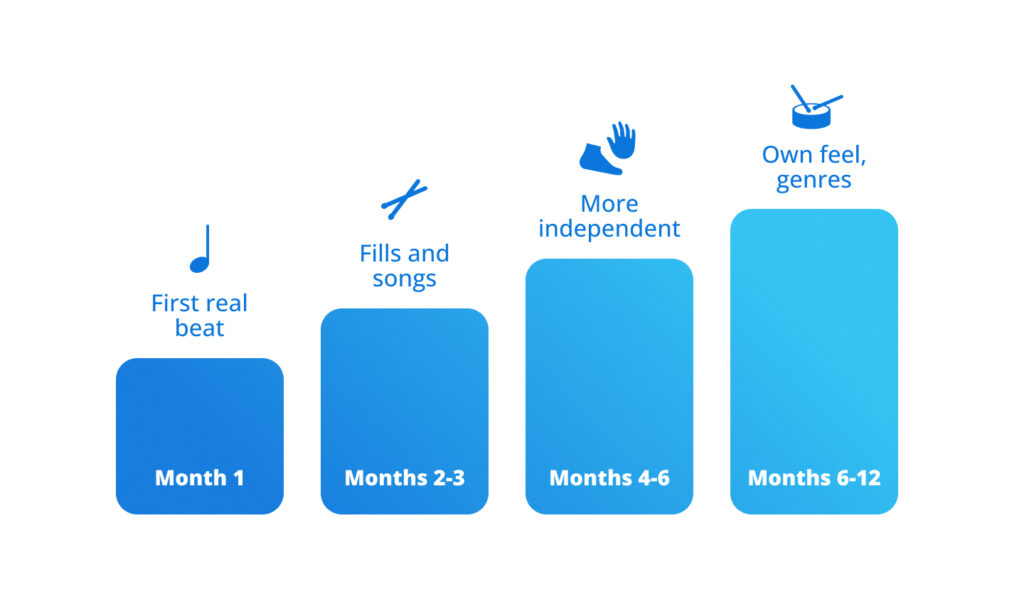
Month 1
Get comfortable with grip, posture, and kit layout. Learn your basic coordination exercise (kick, snare, hi-hat), and work it up to your first real beat.
By the end of the month, you’ll be able to play a basic groove at a steady, comfortable tempo — the same beat behind a huge number of songs you already know.
For a deeper dive on your first exercise & beat, see: How To Learn Drums: The Complete Beginner’s Guide (2026)
Months 2 to 3
Start playing along to full songs. Learn a few beat variations and your first simple fills.
Begin working on dynamics – playing softer and louder sections of a song differently, instead of hitting everything at the same volume.
Months 4 to 6
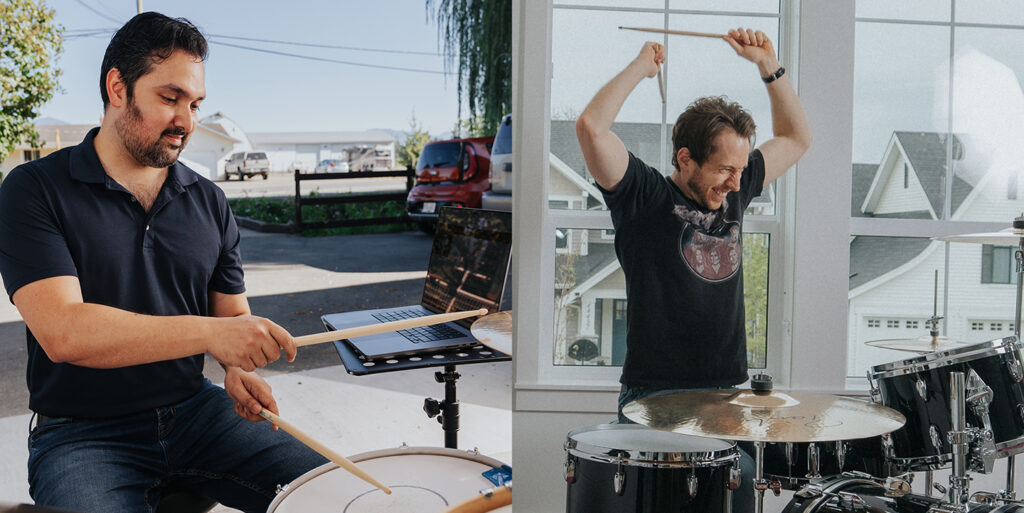
Your hands and feet start feeling more independent from each other.
You’ll be able to play more complex patterns without having to think through each limb separately. This is usually when people start saying, “I’m actually a drummer.”
Months 6 to 12
Explore different genres – funk, blues, and more complex rock and pop patterns.
Fills become more musical and less mechanical. You start developing your own feel rather than just replicating a pattern exactly.
How You'll Know You're Actually Progressing
One of the hardest parts of learning any instrument alone is knowing whether you’re actually improving or just repeating the same session on a loop. This is where a lot of self-taught drummers get discouraged — not because they aren’t progressing, but because they have no way to see it.
A structured platform solves this with built-in progress tracking — logging what you’ve practiced, how consistently, and what skills you’ve actually completed, so “am I getting better?” has a real answer instead of a guess. It’s a small thing, but it’s often the difference between sticking with drums past month two and quietly giving up.
What This Timeline Assumes
This breakdown assumes roughly 10–15 minutes of daily, focused practice with a structured curriculum, not unguided or inconsistent practice.
How Structured Learning Speeds This Up
The biggest timeline-killer for drummers specifically is building bad coordination habits early and having to unlearn them later. A structured method – like the Drumeo Method – introduces coordination challenges in the right order, so you’re not fighting habits you built by guessing.
Concretely, that structure looks like a curriculum broken into levels – starting with fundamentals and building toward more advanced material – plus regular live coaching sessions with working drummers where you can get real feedback on what you’re actually doing wrong, not just guess from a video.
That feedback loop is what closes the gap between “practicing for months” and “actually improving” — it’s genuinely one of the fastest ways to compress a timeline like the one above.
Read the full guide: How To Learn Drums: The Complete Beginner’s Guide (2026)
Where to Go From Here
Here’s How to Take the Next Step
Start free: Drumeo’s Getting Started On The Drums series is free — a step-by-step introduction with Domino Santantonio that takes you from complete beginner to playing your first real beats.
Go deeper: The Drumeo Method gives you a structured, step-by-step curriculum with video lessons from the world’s best drum instructors – the same coordination-building progression that gets total beginners playing real songs.
You’ll also get access to 1,500+ songs to play through, with interactive tools that let you remove the drums, slow down the tempo, and loop the tricky parts until they click.
Click here to start your free 7-day trial.
Keep learning here: This guide is part of a series. Explore our guides on drum rudiments, drum notation, beats and fills, and easy songs to build your skills.
Learning drums is one of the most rewarding things you can do. It doesn’t require natural rhythm. It doesn’t require starting young. It requires 10–15 minutes a day, a willingness to feel uncoordinated for a little while, and a clear path forward.