
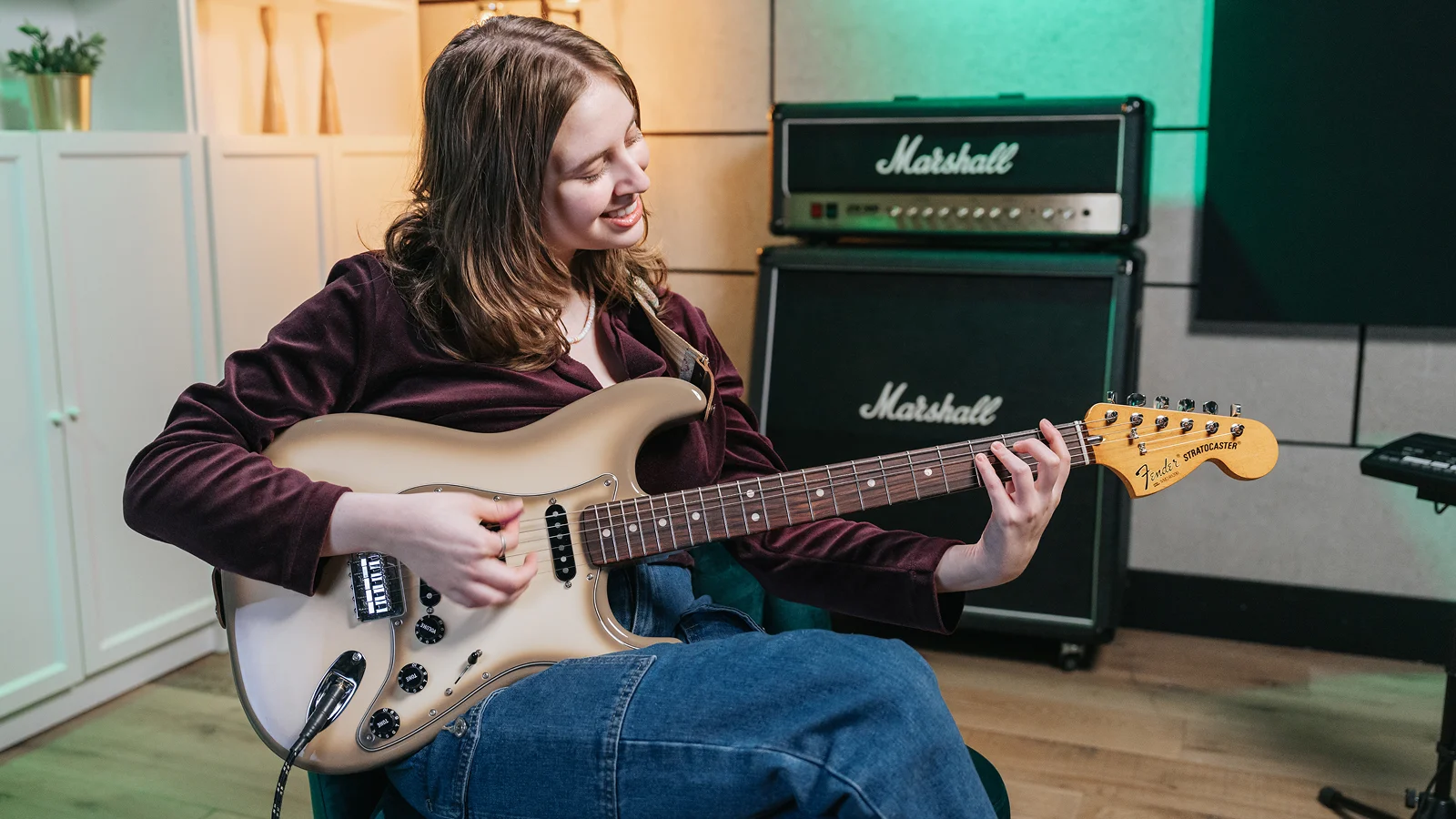
You want to learn guitar. Maybe there’s one sitting in your closet right now, a little dusty. Maybe you’ve watched enough YouTube covers to think, I could probably do that if someone just showed me where to start.
You can. And it’s more approachable than the sore-fingers, forever-out-of-tune reputation suggests.
This guide walks you through everything you need to go from complete beginner to playing your first full song. No prior experience or music theory needed to get started. Just you, a guitar, and about 10–15 minutes a day.
We’ll cover acoustic vs. electric, how the guitar is laid out, your first chords, your first strumming pattern, and how to put it all together into a real song. By the end, you’ll have a clear starting point – and a companion guide covering exactly what to expect month by month after that.
This guide is based on how we teach over 100,000 students at Musora, including our free Getting Started series (Acoustic | Electric) with Ayla Tesler-Mabé – a professional guitarist, vocalist, and songwriter whose instructional videos have helped millions of beginners play their first real song through Guitareo on Musora.
Acoustic or Electric: Which Should You Learn First?
The honest answer: either works. This isn’t the “acoustic builds character, electric is for later” situation some people make it out to be.
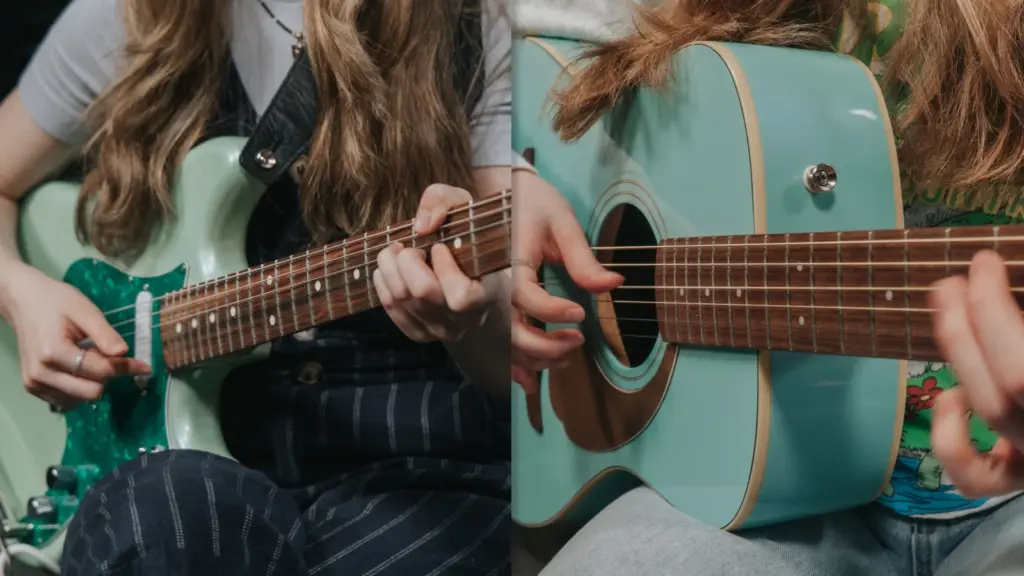
Acoustic doesn’t need an amp, so it’s simpler to just pick up and play anywhere. The strings are a bit tougher on your fingers at first, but that’s a minor difference, not a dealbreaker.
Electric has lighter strings and a slimmer neck, which some beginners find easier on the hands. It does need an amp – even a small practice amp is fine – and headphone-friendly options exist if noise is a concern.
Pick whichever one actually makes you want to play. Motivation matters more than which one is “supposed” to be easier.
What Gear You Actually Need
What to look for:
- A properly set-up guitar. A cheap guitar that’s been set up correctly (strings at a reasonable height, in tune) beats an expensive one that hasn’t. If you’re buying new, ask about a setup, or have a local shop do one.
- A clip-on tuner or tuner app. Playing an out-of-tune guitar is one of the fastest ways to get discouraged for no real reason.
- A few medium-weight picks. Thin picks are easier to strum with early on; you’ll develop preferences over time.
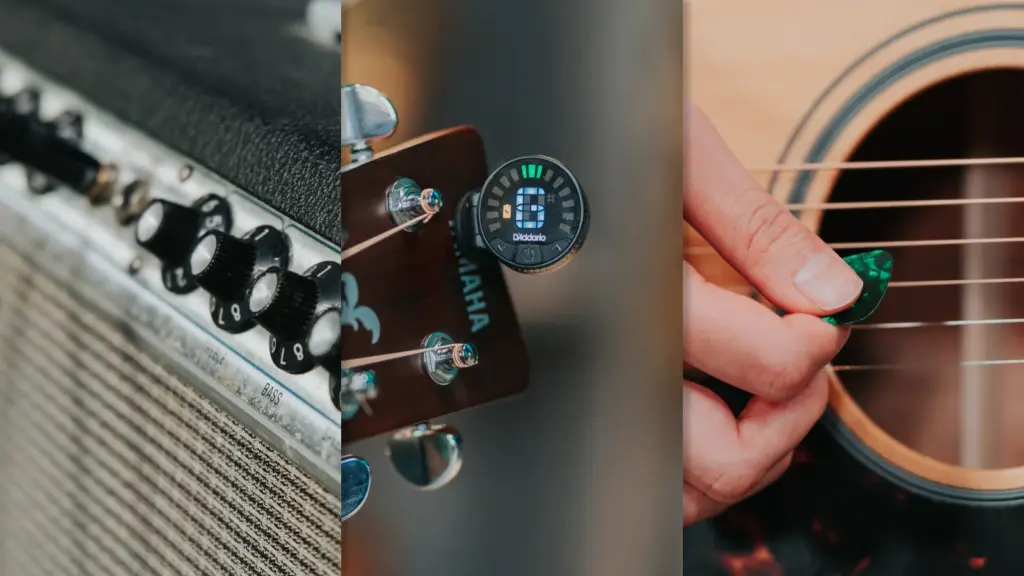
What you don’t need (yet): a capo, a pedal board, multiple guitars, or a top-of-the-line amp. A beginner acoustic or electric-plus-small-amp setup in the $150–$400 range covers you well for the first year or more.
Tip: Keep your guitar out on a stand, not in its case. If it’s not visible, it’s easy to forget.
Anatomy of the Guitar (Quick Reference)
- Headstock – where the tuning pegs live.
- Neck and fretboard – where your fretting hand presses down to change notes.
- Frets – the metal strips dividing the neck into note positions.
- Body – where the sound is produced (acoustically or through pickups on electric).
- Strings – numbered 1 through 6, thinnest (high E) to thickest (low E).
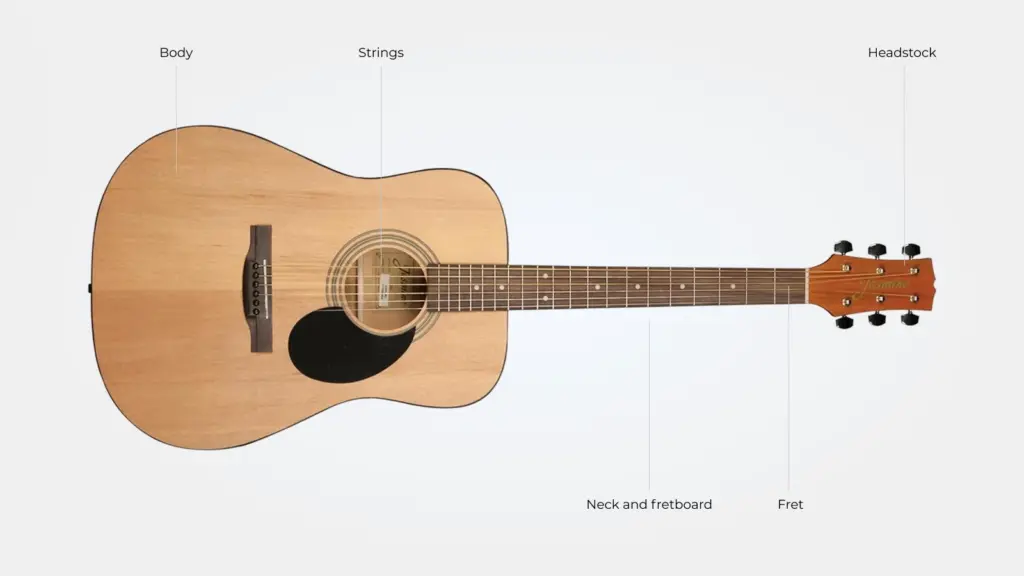
You don’t need to memorize all of this immediately, but it makes every instruction from here forward easier to follow.
How To Hold a Pick (and Why It Matters)
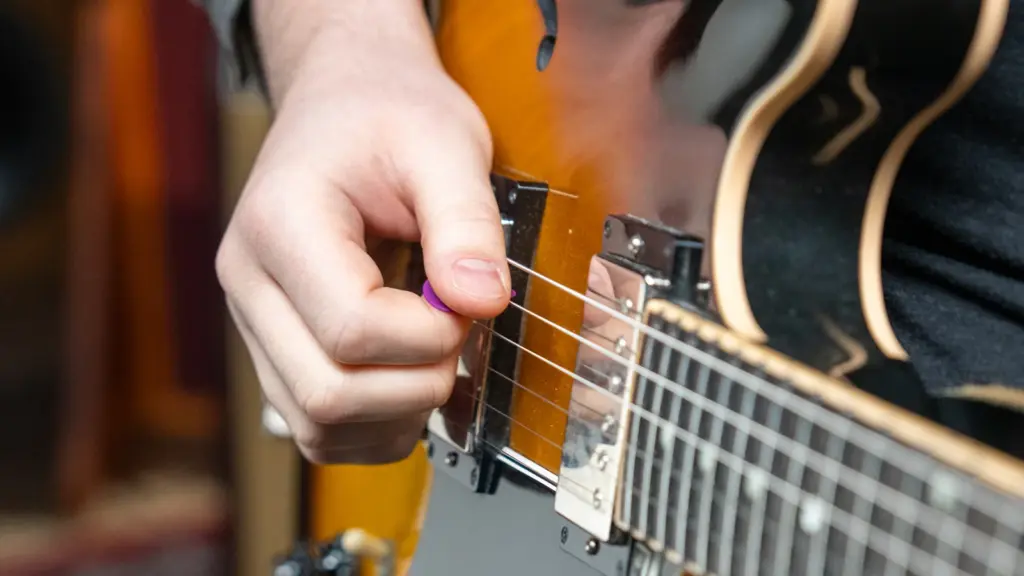
Hold the pick between your thumb and the side of your index finger, with just a small amount of the tip exposed – not the whole pick sticking out. Too much exposed pick makes your strumming feel floppy and uncontrolled; too little makes it hard to strike the strings cleanly.
Relax your grip. A death-grip on the pick is one of the most common tension habits beginners build early, and it’s one of the hardest to unlearn later.
Your First 4 Chords
With just four chords, you can play a huge number of popular songs.
G, C, D, and Em are the classic beginner starting set – common finger shapes, and combinations you’ll see again and again once you start learning real songs.
Practice switching between just two chords at a time before trying all four in sequence – G to C, then C to D, then add Em. Speed comes from clean transitions, not from rushing.
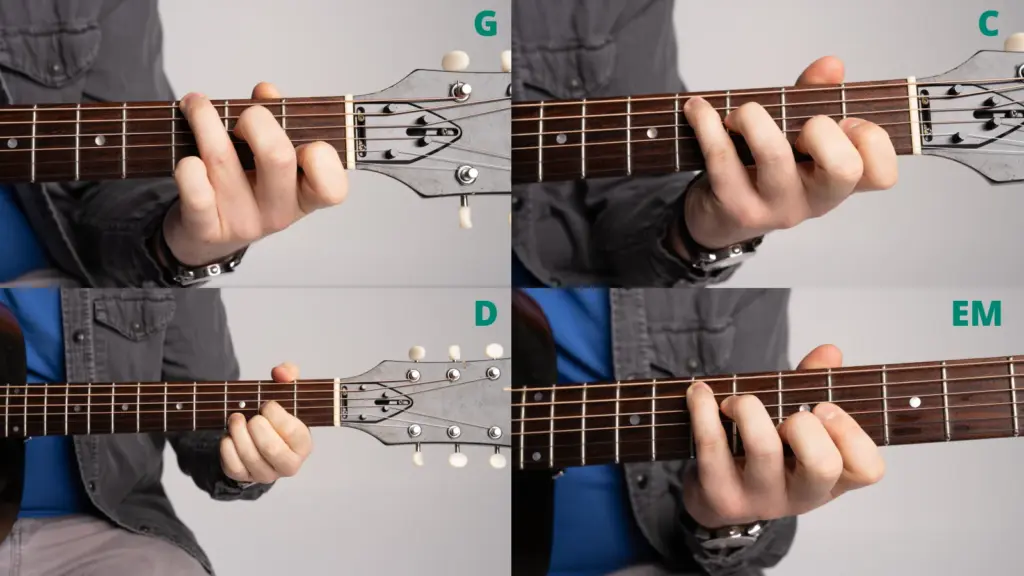
For a complete breakdown with diagrams, see: Essential Guitar Chords For Beginners: The Only Guide You’ll Need. (Coming soon)
Basic Strumming Patterns
Start with a simple down-up pattern – down, down-up, up, down-up – counted against “1, 2-and, 3, 4-and.” Keep your strumming arm moving in a consistent motion, even during the beats you’re not actually hitting the strings; that consistency is what keeps your timing steady.
Don’t worry about sounding polished yet. The goal right now is a steady, repeatable motion – everything else builds on top of that.
To learn these strumming patterns, check out our free series: Getting started on the acoustic guitar or Getting started on the electric guitar.
Scales Every Beginner Should Know
Once chords and strumming feel steady, the pentatonic scale is the natural next step – it’s the foundation for a huge amount of lead guitar playing across rock, blues, and pop, and it’s more approachable than it sounds.
The A minor pentatonic scale (box 1): This is the most common starting shape, creating a ‘box’ on the fretboard which is easily movable and playable all over the neck. This scale uses notes A, C, De, E, and G.
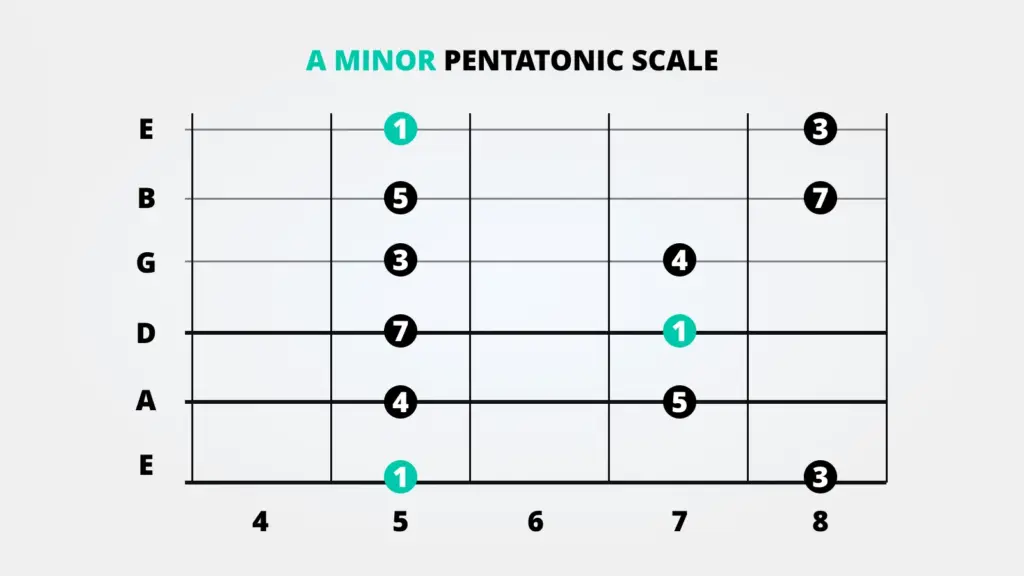
Play through it one string at a time, low to high, then back down – two notes per string, using alternating down-up picking. Keep one finger per fret where possible so your hand stays in position instead of shifting around.
Start slowly with a metronome. The goal at first isn’t speed – it’s landing every note cleanly and evenly before you try to move faster.
This single shape is the backbone of countless guitar solos. Once it’s under your fingers, you’ll start recognizing it in songs you already know.
For a deeper dive, see: Guitar Scales For Beginners: Where To Start. (Coming soon)
Common Beginner Mistakes That Slow You Down
After teaching thousands of new guitarists, the same mistakes show up again and again. Avoid these, and you’ll progress faster than most:
- Gripping the neck too hard. It feels like more control, but it actually restricts your fretting hand and tires you out fast. Use just enough pressure to sound the note clearly – nothing more.
- Pressing way harder on the strings than necessary. Related to the grip issue above. Beginners often press with far more force than a clean note actually requires, which slows down chord changes and causes unnecessary finger pain.
- Avoiding barre chords entirely. They’re uncomfortable at first, so it’s tempting to only learn songs that dodge them. But barre chords unlock a huge amount of music – pushing through the early discomfort pays off fast.
- Practicing without a tuner. An out-of-tune guitar makes everything sound wrong, even when you’re playing correctly, which is deeply discouraging for no real reason. Tune before every single session.
- Learning without structure. Bouncing between random YouTube videos is fun, but without a clear order, you create gaps – usually in rhythm and timing – that later show up as bad habits. A structured method like the Guitareo Method ensures you build each skill in the right sequence.
For the full list, read: Common Guitar Mistakes Beginners Make (And How To Fix Them). (Coming soon)
Where to Go From Here
You’ve got the foundation: gear, your first chords, a strumming pattern, and a full song. Wondering what’s realistic to expect from here? We’ve laid it out month by month in a companion piece.
Read next: How Long Does It Take To Learn Guitar? (Month-By-Month Timeline)
Here’s How to Take the Next Step
Start free: Guitareo’s free Getting Started series with Ayla Tesler-Mabé covers both acoustic and electric guitar – taking you from the absolute basics to playing your first full song.
Go deeper: The Guitareo Method gives you a structured, step-by-step curriculum with video lessons from real teachers, technique breakdowns, and song breakdowns that turn every skill into real playing. You’ll also get access to 1,000+ songs to play through, with tools to slow down tricky sections and loop them until they click. It’s how 100,000+ students learn.
Keep learning here: This guide is part of a series. Explore our guides on guitar chords, guitar scales, easy songs, and common mistakes to build your skills.
Learning guitar is one of the most rewarding things you can do. It doesn’t require natural talent. It doesn’t require starting young. All it takes is 10–15 minutes a day, a willingness to sound rough for a little while, and a clear path forward.