Short answer: With about 10–15 minutes of daily practice and a structured approach, most beginners play simple root-note basslines within their first couple of weeks, lock in with a full song by month three, and explore real genre variety by month six. By the one-year mark, most players are jamming comfortably with others.
Here’s what that actually looks like, month by month – and why bass often moves faster early on than people expect. And if your progress doesn’t match this exactly – that’s fine too. Every hand, every schedule, every player is a little different. This is a guide, not a race.
Why Bass Often Progresses Faster Than Guitar Early On
Fewer strings, no chord shapes to memorize immediately, and a groove-focused rather than chord-focused starting point mean bass beginners are often playing functional, real music sooner than guitar beginners.
The early wins come faster – even though mastering feel and timing is its own long-term skill.
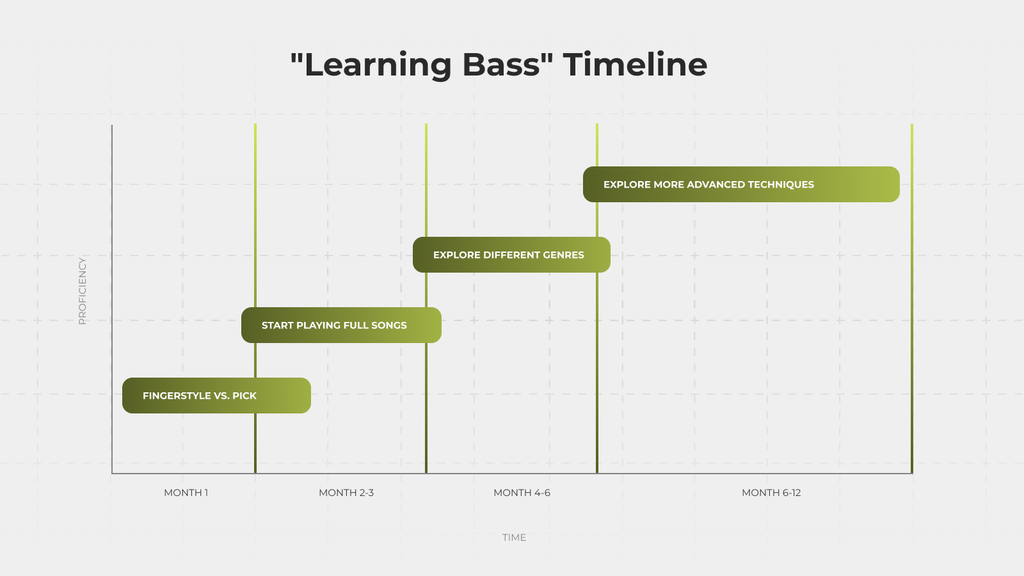
Month 1
If you haven’t already, this is also when you’ll want to settle on fingerstyle or pick technique – most beginner curricula start with fingerstyle, since it builds foundational control.
Get comfortable with your instrument, basic finger technique (or pick technique), and reading simple bass tab. Learn root-note basslines and how to lock into a steady beat. By the end of the month, you’ll be playing a real, functional bassline.
To learn more, see: How To Learn Bass Guitar: The Complete Beginner’s Guide (2026)
Months 2 to 3
Start locking in with full songs, not just isolated exercises.
Learn a few more advanced techniques, like simple fills between phrases and basic scale patterns. Timing gets noticeably tighter.
Months 4 to 6
Play full songs across different genres.
Your groove feel develops – you start anticipating where the pocket sits instead of just hitting the right notes on time.
Months 6 to 12
Explore more advanced techniques – slap, more complex fingerstyle patterns, walking basslines.
You start playing with real confidence in a band or jam setting.
How You'll Know You're Actually Progressing
One of the hardest parts of learning bass alone is knowing whether you’re actually improving, or just repeating the same session on a loop. This is where a lot of self-taught players get discouraged – not because they aren’t progressing, but because they have no way to see it.
A structured platform solves this with a real progress tracker and daily/weekly streaks – logging every lesson, song, and practice session, so your consistency turns into something visible instead of a guess. It’s a small thing, but it’s often the difference between sticking with bass past month two and quietly giving up.
What This Timeline Assumes
This breakdown assumes roughly 10–15 minutes of daily, focused practice with a structured curriculum, not unguided or inconsistent practice.
How Structured Learning Speeds This Up
The biggest timeline-killer for bass specifically is practicing without any feedback on your timing or groove – it’s genuinely hard to hear your own rushing or dragging without an outside ear. A structured path with real instructors, like the PlayBass Method, builds skills in the right order and gives you a way to check your progress instead of guessing.
Concretely, that also includes a real song library with tools that let you remove the bass track and play the part yourself, loop tricky sections, and control the tempo, which closes the gap between “practicing for months” and “actually improving” faster than practicing in isolation ever could.
Read the full guide: How To Learn Bass Guitar: The Complete Beginner’s Guide (2026)
Where to Go From Here
Try PlayBass: PlayBass gives you a structured, step-by-step learning path with video lessons from Chris Wong and the PlayBass team, real feedback from world-class teachers, and a supportive community of aspiring musicians in the same boat as you. Your first week is completely free, so you can try the full PlayBass experience before deciding if it’s right for you.
→ Click here to start your free 7-day trial.
Keep learning here: This guide is part of a series. Explore our guides on easy bass songs and common mistakes to build your skills.
Learning bass is one of the most rewarding things you can do. It doesn’t require natural talent. It doesn’t require starting young. It requires 10–15 minutes a day, a willingness to sound rough for a little while, and a clear path forward. And somewhere in there – don’t forget to have fun with it.