
I’ve taught piano for decades, and I can usually tell within the first few minutes of a lesson which habits a student picked up on their own before finding an instructor. They’re rarely dramatic mistakes – mostly small things that felt fine in the moment and just never got corrected. The tricky part is that by the time they’re noticeable, they’ve often been practiced hundreds of times.
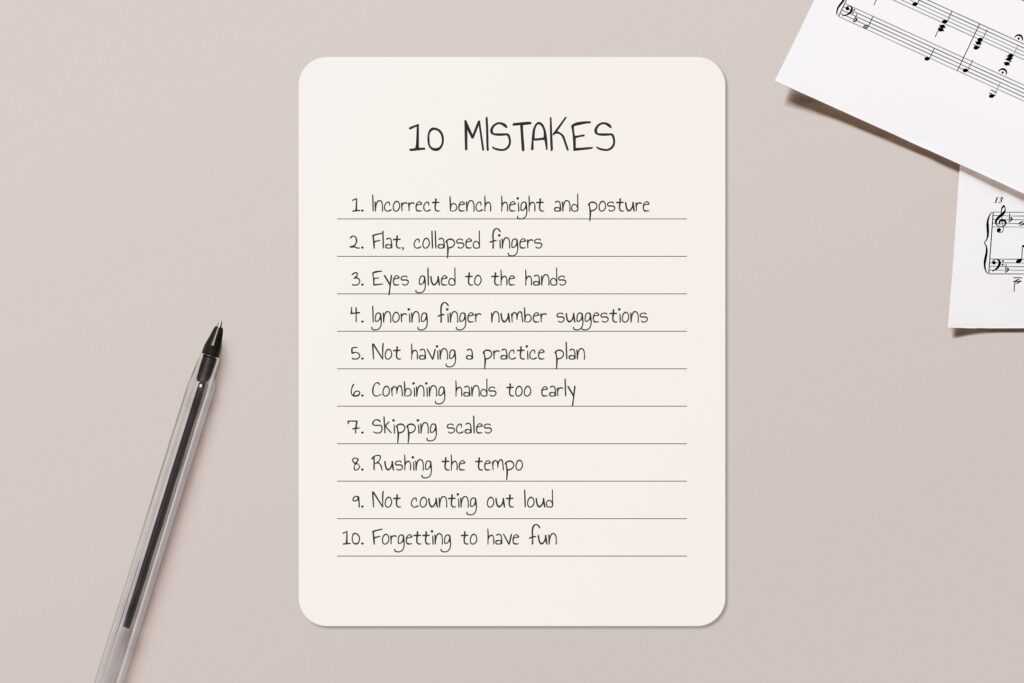
Here are the ten I see most, roughly in the order they tend to show up as you’re learning.
Bench Height and Posture
This is always where I start, because it affects everything that comes after it.
Sit too low, and your wrists end up below the keys, which limits your ability to move fluidly across the keyboard. Sit too far away, and you’ll be reaching for the keys, which will strain your posture and make you feel uncomfortable. Neither is dramatic on its own, but they compound – a student with poor bench setup is usually also fighting tension somewhere else without realizing the two are connected.
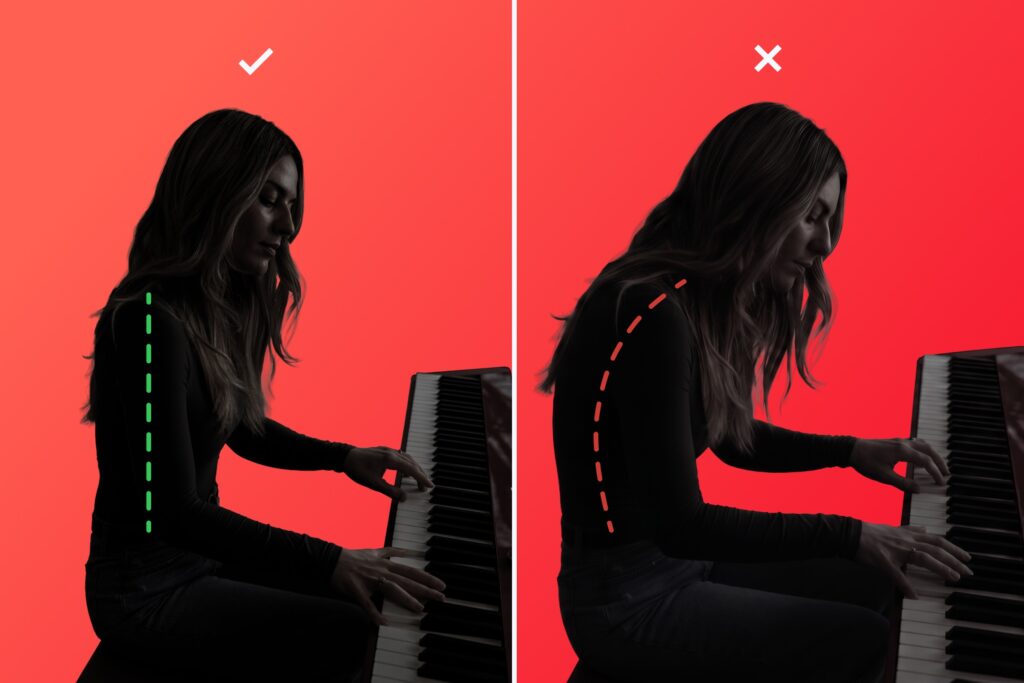
Posture is easy to get right when we first sit down at the bench. Honestly, most of us know what good posture looks like. But as we focus (and when we’re learning something new, we really focus!), we tense up. Shoulders creep toward our ears, and we might find ourselves leaning in to see the music better.
Flat, Collapsed Fingers
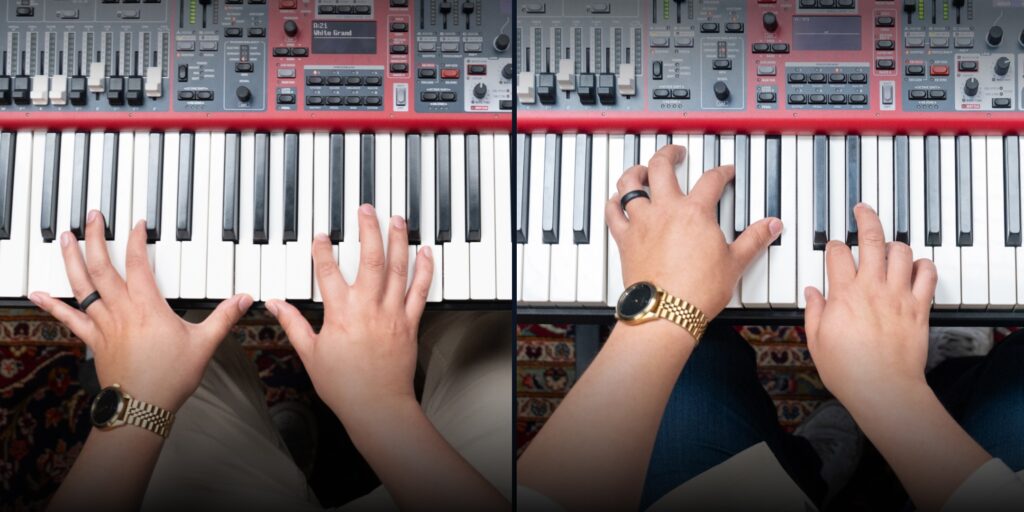
Curved fingers aren’t a stylistic choice – they’re mechanically stronger, and they give each finger room to move independently.
A flat hand shape works fine for the first few weeks of lessons, and that’s exactly the problem: it works just well enough that nobody notices it’s limiting them until pieces get harder down the line.
Eyes Glued to the Hands
I actually encourage new students to glance down often – that’s totally normal and helpful.
But there’s a difference between a quick glance and staring, and studying your hands the whole time does two things against you: it’s exhausting on your neck, and it stops your fingers from building the spatial memory they need to find keys on their own.
If you never let your eyes look away, your hands never get the chance to learn what they already know how to do.
Ignoring Finger Number Suggestions
Finger numbers show up everywhere – sheet music, scales, arpeggios, chord inversions, warm-ups like Hanon – and they’re never arbitrary.
Someone worked out the most efficient hand path through that passage before you ever saw the page. Ignore the suggestion and you’ll often land in a position that makes the next phrase awkward, even if the current one felt fine. It’s one of those mistakes that doesn’t punish you immediately, which is exactly why it’s easy to keep making.
Not Having a Practice Plan
This might be the most common mistake I see.
A student sits down, plays through whatever feels familiar or fun that day, and calls it practice. There’s nothing wrong with that occasionally – but without a plan, progress becomes accidental instead of consistent. You end up reinforcing what you already know instead of building what you don’t.
Worse, not knowing what to practice is often enough of a barrier on its own to kill the motivation to practice at all.
The fix isn’t complicated: know what you’re working on before you sit down, not after. That’s exactly what our Method is built for – a clear, structured path that tells you what to practice and why, every step of the way.
If you’ve never tried it, our free 7-day trial is a great way to see the difference a real plan makes.
Combining Hands Too Early
Hands together feels like real progress, so it’s tempting to rush there. But each hand needs to be genuinely comfortable with its own part first – otherwise you’re not combining two solid parts, you’re combining two shaky ones and hoping they sort themselves out. They usually don’t, at least not without a lot of extra practice time you didn’t need to spend.
Skipping Scales
I hear this one a lot: “I just want to play songs, not exercises.”
Don’t get me wrong, I totally get it – but scales aren’t separate from songs, they are the songs, broken down into their raw material. Every piece you’ll ever learn draws from patterns that scales teach your hand to recognize automatically. Skip them, and you’re relearning those patterns from scratch in every new piece instead of once.
If you want to go deeper, check out our complete beginner guide to piano scales.
Rushing the Tempo
The fastest way to get faster is by slowing down.
If a passage isn’t clean at a slow tempo, playing it faster doesn’t fix that – it just makes the mistakes happen quicker. This is one of the hardest habits to break because slow practice can feel like you’re not making progress, when it’s actually the opposite.
Speed is a byproduct of accuracy, not a separate skill you practice on its own.
Not Counting Out Loud
I never wanted to count out loud because I felt silly.
But that feeling fades fast once you hit something syncopated or unfamiliar and realize you can’t actually “feel” your way through it. Students who count out loud early build a much more reliable internal clock than students who rely on instinct from day one. It’s a small habit that pays off exactly when you need it most – even if it feels a little uncomfortable at first.
Forgetting to Have Fun
Put in the work and practice, but always leave room to just play!
I still remember why I fell in love with the piano in the first place, and it wasn’t from drilling scales. It was from the days I let myself noodle around, play a song purely because I loved it, or chase a melody just to see where it went. None of the techniques in this article matter if you lose that.
Remember, playing piano and making music should be fun! That’s really what it’s all about.
You don’t need to tackle all ten at once – pick the one that sounds most like you, work on it deliberately for a couple of weeks, and then move to the next. Technique built this way tends to stick, because you’re fixing one honest thing at a time instead of trying to overhaul everything overnight.
Want to Go Even Deeper?
If you recognized yourself in a few of these, that’s completely normal – and it’s also exactly where structured lessons make the biggest difference.
Inside Pianote on Musora, our step-by-step Method is built to catch habits like these early, with real instructors guiding you through proper technique from the very first lesson. Click here to try it free for 7 days and see for yourself.
You’ll get unlimited access to our step-by-step learning paths, 62 deep-dive courses, note-for-note breakdowns of over 1,000 songs in our lead sheet view, and so much more.